

Table of Contents
- Why Hydration Is Key to Anti-Aging: The Basics
- How Dehydration Affects Skin Appearance and Barrier Function
- Does Drinking Water Help Wrinkles? What the Evidence Shows
- Daily Water Intake for Adults: How Much Is Enough
- Signs of Dehydration in Older Adults to Watch For
- How to Stay Hydrated as You Age: A Simple Daily Plan
- Conclusion: Building Hydration Into Your Anti-Aging Routine
- Frequently Asked Questions
Last Updated: October 4, 2026
Why Hydration Is Key to Anti-Aging: The Basics
This is why hydration is key to anti-aging: water supports nearly every system that keeps skin and the body looking and feeling younger. At Ageless Glow, we see this play out in two ways: how your body runs on the inside, and how your skin looks on the outside. Water carries nutrients to cells, helps flush waste, and keeps tissues plump.
Here's the catch most people miss: your thirst signal weakens with age. So you can be low on fluids and not feel thirsty at all.
Water also helps regulate body temperature, supports kidney function, and aids cellular repair. In short, it's not a beauty gimmick. It's basic maintenance for healthy aging.
How Dehydration Affects Skin Appearance and Barrier Function
Dehydration weakens the skin barrier, the outer layer that locks in moisture and keeps irritants out. A weak barrier means more water escapes, so skin looks dull, tight, and dry.
Think of the barrier as a brick wall. Skin cells are the bricks, and fats and water are the mortar. Run low on water and the mortar cracks. That's when you notice:
- Dry, flaky patches
- Itchy, irritated skin
- A dull, uneven complexion
- More visible fine lines
Drinking water supports barrier function from the inside. But it can't do the whole job alone. This is where the evidence gets interesting.
Skin Moisture, Elasticity, and the Look of Fine Lines
Skin elasticity is the ability to stretch and snap back. It depends on collagen and elastin, plus how much water your skin holds.
Hydrated skin looks plumper, so fine lines appear softer. Dehydrated skin looks flatter, so the same lines look deeper. That's a temporary effect, not a permanent change.
This matters for how you set expectations. Drinking more water can improve how your skin looks day to day. It won't erase deep wrinkles on its own.
Does Drinking Water Help Wrinkles? What the Evidence Shows
The honest answer: drinking water supports skin looking better, but it does not reverse wrinkles by itself. This is the part most guides get wrong, and it is worth being precise about why.
Two Different Systems: Inside and Outside
Skin hydration comes from two separate pathways, and they are often conflated:
- Systemic hydration is the water you drink. It supports blood volume, nutrient delivery, and normal cell function, including the cells in your skin.
- Topical hydration is what you put on your skin. Moisturizers, humectants, and occlusives reduce water loss through the outer layer and help the skin barrier hold onto moisture.
Drinking more water can improve how skin looks day to day, especially if you were dehydrated to begin with. But it does not travel directly to the surface and plump fine lines the way a moisturizer does. The two work on different layers and at different speeds.
What the Research Generally Shows
Research on hydration and skin generally supports a modest relationship: good fluid intake is associated with skin moisture and elasticity, and dehydration is associated with drier, less elastic skin. The effect is real but not dramatic, and it works best alongside skincare that holds water in. No credible evidence supports the idea that drinking extra water erases deep wrinkles or reverses photoaging on its own.
Why the Skin Barrier Does the Heavy Lifting
Your skin barrier is the outer layer that keeps water in and irritants out. It is made of skin cells (the bricks) surrounded by fats and water (the mortar). When the barrier is compromised, water escapes faster no matter how much you drink. That is why topical care matters: it reinforces the mortar.
Two categories of ingredients do most of the work:
- Humectants like hyaluronic acid, glycerin, and niacinamide attract and hold water in the upper layers of skin.
- Occlusives like petrolatum, squalane, and some plant oils slow water loss by forming a light seal.
A practical routine pairs both: a humectant serum under a moisturizer that seals it in.
Setting Realistic Expectations
Here is the two-part approach that matches the evidence:
- Inside: Drink enough fluid to support normal body functions and avoid dehydration.
- Outside: Use skincare that draws in and seals moisture, and protect your skin from sun exposure, which is the single largest driver of visible aging.
For the outside piece, a humectant like hyaluronic acid attracts water to the skin's surface. Our Hyaluronic Acid & Niacinamide Hydrating Serum pairs hyaluronic acid with niacinamide to plump skin and refine pores. That is the topical half of the hydration equation. For deeper guidance, the American Academy of Dermatology on skin care is a solid, independent reference.

Daily Water Intake for Adults: How Much Is Enough
There is no single correct number of cups for every adult. A commonly cited general reference is about 8 cups (roughly 64 ounces) of fluid per day, but that figure is a rough starting point, not a prescription. Your real needs shift with body size, activity level, climate, diet, pregnancy or breastfeeding, and any health conditions or medications you take.
The National Academies of Sciences, Engineering, and Medicine fluid intake guidance frames total water needs as coming from all sources, not just plain water. That includes drinking water, other beverages, and water-rich foods. So soup, coffee, tea, milk, broth, cucumber, watermelon, and lettuce all contribute to your daily total.
What Actually Changes Your Fluid Needs
| Factor | How It Shifts Your Needs |
|---|---|
| Hot or humid weather | Raises needs because you sweat more |
| Exercise or physical work | Raises needs; more with longer or sweatier sessions |
| Fever, vomiting, or diarrhea | Raises needs and can require medical guidance |
| Pregnancy or breastfeeding | Raises needs |
| High-fiber or high-protein diets | Can raise fluid needs |
| Certain medications (diuretics, some blood pressure drugs, lithium) | Can raise or lower needs |
| Kidney, heart, or liver conditions | May require a clinician-set limit |
| Older age | Thirst signal weakens, so needs may not feel obvious |
Hydration Beyond Plain Water
Plain water is the simplest option, but it is not the only one. Herbal tea, milk, and broth add fluid and, in some cases, electrolytes. Coffee and tea count toward fluid intake for most healthy adults, though the caffeine can have a mild diuretic effect that is usually offset by the fluid in the drink itself.
Hyaluronic Acid & Niacinamide Hydrating Serum →
Water-rich foods are an underused tool. Cucumber, watermelon, strawberries, lettuce, zucchini, and soups are roughly 90 percent water or more, so they add to your total without feeling like you are drinking constantly.
A Simple Daily Tracking Plan
Instead of chasing one universal number, build a routine you can actually keep:
- Start the day with one full glass of water before coffee or breakfast
- Keep a refillable bottle within arm's reach at home and at work
- Drink a glass with every meal and with any medication you take with water
- Add at least one water-rich food at lunch or dinner
- Set two or three phone reminders, spaced across the day rather than clustered
- Check urine color once or twice a day as a quick feedback loop
A practical check: pale yellow urine usually suggests you are well hydrated. Dark yellow or amber suggests you need more fluid. Urinating much less often than usual is another signal to pay attention to.
If you take diuretics, blood pressure medication, lithium, or have kidney, heart, or liver conditions, your fluid needs may be limited or require close monitoring. Do not change your water intake based on a general target without checking with your doctor first.
Tie drinking water to habits you already have, like taking your morning vitamins, brushing your teeth, or starting your skincare routine. Anchoring a new habit to an existing one makes it stick far better than relying on memory or willpower alone.
For most healthy adults, the goal is not a perfect number. It is a steady pattern that keeps you out of the dehydration zone, especially as thirst becomes a less reliable signal with age.
Signs of Dehydration in Older Adults to Watch For
Signs of dehydration in older adults are easy to miss because thirst fades with age. The thirst response weakens, so waiting to feel thirsty is a bad strategy.
Watch for these signs:
- Dark yellow urine or urinating less often
- Dry mouth, cracked lips
- Fatigue or confusion
- Dizziness when standing
- Headaches
- Dry, dull skin
If you take diuretics, blood pressure medication, or have kidney or heart conditions, your fluid needs may be limited. Never change your water intake without checking with your doctor first.
This is one of the areas most guides skip. Older adults face higher dehydration risk, and it's a real health issue, not just a skin one.
How to Stay Hydrated as You Age: A Simple Daily Plan
Learning how to stay hydrated as you age comes down to routine, not willpower. Small, repeated habits beat big one-time efforts.
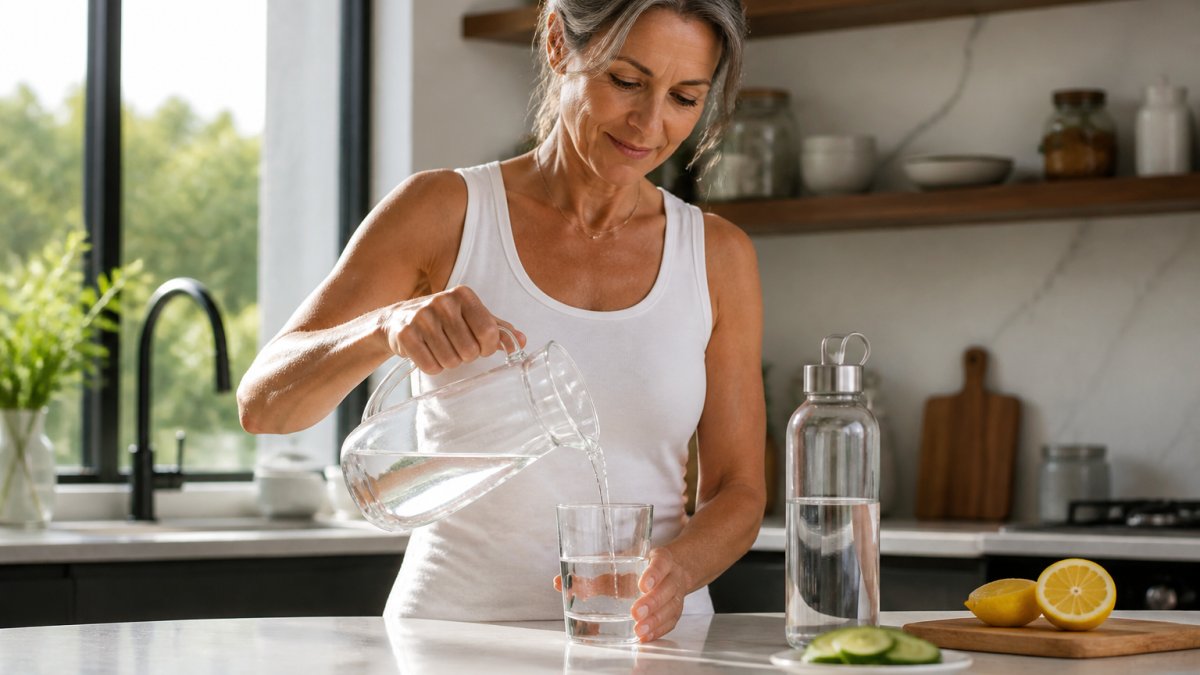
Try this daily plan:
- Start the day with one full glass of water
- Keep a bottle within arm's reach all day
- Drink a glass with every meal
- Add water-rich foods: cucumber, watermelon, soup
- Set two or three phone reminders
- Pair a glass with your skincare routine, morning and night
Hydration beyond plain water counts too. Herbal tea, milk, and broth all add fluid. Our All-Day & Night 2-Pack Cream pairs a day shield with a night renewal cream, using Centella Asiatica and niacinamide to support smooth, hydrated skin around the clock.

Conclusion: Building Hydration Into Your Anti-Aging Routine
The challenge is consistency. Most people drink plenty for a few days, then slip back into old habits. The fix is making hydration automatic and pairing it with skincare that locks in moisture.
At Ageless Glow, we built our lineup around this idea. Our nutrient-rich formulas support hydration from the outside while you handle the inside. Start with the Hyaluronic Acid & Niacinamide Hydrating Serum for daily moisture, add the All-Day & Night 2-Pack Cream for round-the-clock support, and let your water bottle do the rest.
Get started with Ageless Glow and give your skin the steady hydration it needs for visible, lasting results.
Frequently Asked Questions
Can drinking more water reduce wrinkles?
Drinking water supports overall fluid balance and helps your skin stay hydrated from the inside, which can soften the look of fine lines caused by dryness. It will not erase wrinkles formed by sun damage, collagen loss, or genetics. Think of water as one part of a hydration anti-aging routine that also includes a moisturizer and a serum with humectants like hyaluronic acid, which help hold water in the skin.
How much water should adults drink each day?
Most adults need roughly 9 to 13 cups of fluid per day, with needs rising in hot weather or with exercise. Daily water intake for adults is not one fixed number: body size, activity level, medications, and health conditions all shift it. A practical check is urine color, which should stay pale yellow. Water-rich foods like soup, melon, and cucumber also count toward your total.
What are the signs of dehydration in older adults?
Signs of dehydration in older adults include dark urine, dry mouth, fatigue, dizziness on standing, confusion, and headaches. Thirst becomes a less reliable cue with age, so waiting to feel thirsty can mean you are already behind. Watch for reduced urination, sunken eyes, and sudden weakness. If confusion or fainting appears, treat it as urgent and seek medical care.
What is the difference between skin hydration and drinking water?
Drinking water supports your body's fluid balance and delivers moisture to tissues, but skin hydration depends on the skin barrier holding that water in. A weakened barrier lets moisture escape no matter how much you drink. That is why topical steps matter: a serum with hyaluronic acid and niacinamide draws in and retains moisture, while a daily moisturizer helps seal it. Pair both for the best results.