

Table of Contents
- Why You Need to Verify Natural Skincare Ingredient Claims
- Understanding Ingredient Labels and the INCI List
- FDA Cosmetic Labeling Regulations: What They Do and Don't Cover
- Common Greenwashing Tactics in Skincare to Watch For
- How to Use a Skincare Ingredient Checker for Quick Verification
- Your Step-by-Step DIY Verification Workflow
- Conclusion
- Frequently Asked Questions
Last Updated: September 5, 2026
Why You Need to Verify Natural Skincare Ingredient Claims
The beauty industry spends billions convincing you that a single word on a label means your skin will transform overnight. The honest truth is that "natural" is a marketing term, not a regulated standard, which is why you need to learn how to verify natural skincare ingredient claims before you spend another dollar on a jar of promises.
Skincare ingredient verification is the process of confirming that what a brand claims about its formula matches what is actually inside the product. This matters because your skin absorbs what you apply, and the difference between a genuinely effective natural formula and a heavily marketed synthetic one is often hidden in plain sight on the ingredient deck.
Below, we'll walk you through a practical, non-technical framework for checking those claims yourself, from decoding the INCI list to spotting the greenwashing tactics that even savvy shoppers fall for.
Understanding Ingredient Labels and the INCI List
The INCI list is the standardized inventory of ingredients printed on every cosmetic label, and it is the single most reliable tool you have for verifying what is really in your skincare. INCI stands for International Nomenclature of Cosmetic Ingredients, and it uses Latin and scientific names rather than friendly marketing language.
When you see "water" on a label, the INCI will list it as "Aqua." When a brand wants to highlight its star botanical, the INCI will use the plant's Latin name, such as Curcuma Longa for turmeric. This matters because it strips away the fluff and reveals the actual chemical composition.
A common mistake is assuming that a long, unpronounceable name means the ingredient is synthetic. Many plant-derived compounds have complex chemical names because that is simply what chemistry requires. The reverse is also true: some brands use the word "natural" on the front while the INCI list tells a different story about what is actually inside.
FDA Cosmetic Labeling Regulations: What They Do and Don't Cover
Most shoppers assume that if a product is on a store shelf, a government agency has verified its claims. That assumption is wrong, and understanding exactly why is the first step in building a reliable verification habit.
The FDA's authority over cosmetics comes from the Federal Food, Drug, and Cosmetic Act (FD&C Act). Under this law, cosmetics do not require premarket approval. Unlike pharmaceutical drugs, which must undergo clinical trials and receive FDA clearance before reaching consumers, a moisturizer or serum can be formulated, bottled, and sold without the agency ever reviewing its ingredient list or marketing language first (the FDA).
The FDA does require that ingredient labels be "truthful and not misleading" and that products not be "adulterated" or "misbranded." But here is the legal loophole that matters for your verification work: the FD&C Act does not define the terms "natural," "clean," "botanical," or "chemical-free." These words have no regulatory meaning. A brand can legally slap "all-natural" on a bottle of primarily synthetic ingredients because no federal standard exists to contradict that claim.
This regulatory gap was partially addressed by the Modernization of Cosmetics Regulation Act of 2022 (MoCRA), which gave the FDA new authority over cosmetic safety. MoCRA requires brands to register their facilities and products with the FDA, maintain adverse event records, and ensure products are manufactured under good manufacturing practices (the FDA). However, MoCRA does not define "natural" either. It focuses on safety infrastructure, not marketing semantics. A brand can be fully MoCRA-compliant and still use the word "natural" in ways that stretch credibility.
The FDA can take enforcement action against a product that is genuinely dangerous or whose label is affirmatively false in a way that poses a health risk. But the agency's resources are limited, and its enforcement priorities center on safety issues like contamination or undeclared allergens, not on policing whether a "botanical blend" contains enough plant extract to matter. The practical reality is that the FDA's role is safety oversight, not claim substantiation.
What this means for your verification workflow is straightforward: regulatory compliance tells you a product is legally sellable, not that its natural claims are accurate. The burden of verifying ingredient truthfulness falls on the manufacturer, and the burden of verifying the manufacturer falls on you. That is why the DIY workflow in this guide matters, it fills the gap that federal regulation leaves open.
Common Greenwashing Tactics in Skincare to Watch For
Greenwashing is not a single trick, it is a toolkit of rhetorical and visual strategies designed to short-circuit your critical thinking. Once you can name the tactic, you can spot it in seconds. Here are the patterns that show up most frequently on skincare labels.
The "Green Sheen" Package. The most obvious tactic is visual. A brand wraps its product in recycled-looking kraft paper, uses a sage green palette, and prints a leaf icon next to the word "natural." None of these visual cues have any regulatory meaning. The packaging design is a marketing decision, not a formulation decision. A genuinely natural product can come in a bright pink jar, and a heavily synthetic one can come in packaging that looks like it was woven from organic hemp.
The "Hero Ingredient" Misdirection. A brand splashes "Infused with 24K Gold and Caviar Extract" across the front of the bottle. You flip it over, and those ingredients sit near the bottom of the INCI list, after the preservatives. In cosmetic formulation, ingredients are listed in descending order of concentration (the FDA). Anything after the first five ingredients is typically present at less than 1%. If the hero ingredient appears after the preservative system, it is there for label appeal, not for skin impact. The formula's real work is being done by the ingredients you have never heard of.
The "Free-From" Fallacy. "Paraben-free," "sulfate-free," "phthalate-free," "fragrance-free", these claims sound reassuring, but they are often meaningless or misleading. Many "free-from" claims target ingredients that are already restricted or that have safe alternatives. A brand can say "paraben-free" while using a different preservative system that is equally effective but less well-known. The absence of one ingredient does not make a formula natural or safe. It only tells you what is not in the bottle, not what is.
The "Naturally Derived" Shell Game. This is one of the most deceptive phrases in the industry. "Naturally derived" can mean that an ingredient started as a plant and was then chemically modified in a lab. Sodium coco-sulfate, for example, is derived from coconut oil but undergoes significant chemical processing to become a cleansing agent. The word "derived" is doing a lot of work here. A brand can claim its cleanser is "naturally derived" when the final molecule bears little resemblance to anything found in nature.
The Undisclosed Fragrance Dodge. Under FDA labeling rules, a brand can list "fragrance" or "parfum" on the INCI list without disclosing the individual components. That single word can legally mask dozens of synthetic compounds, including known allergens and potential irritants. If a brand claims to be "clean" or "natural" but hides behind undisclosed fragrance, you have a direct contradiction. A truly transparent brand will either list its fragrance components individually or state that it uses only essential oils for scent.
The "Eco" Distraction. Some brands lean heavily on environmental claims, recyclable packaging, carbon-neutral shipping, reef-safe formulas, to distract from a mediocre ingredient deck. These are worthwhile attributes, but they are not the same as a clinically effective natural formula. A product can be packaged sustainably and still contain a preservative system that irritates sensitive skin. Evaluate the formula on its own merits, then factor in the sustainability story as a bonus, not a substitute.
How to Use a Skincare Ingredient Checker for Quick Verification
A skincare ingredient checker is an online database or app that lets you search for individual ingredients and see their function, safety profile, and potential irritants at a glance. These tools are the fastest way to verify natural skincare claims because they translate chemical nomenclature into plain language.
For quick verification, follow this process:
- Find the full INCI list on the product label or brand website
- Identify the first five ingredients, which make up the bulk of the formula
- Search each of those five ingredients in a reputable checker database
- Look up the star ingredient the brand markets on the front of the bottle
- Check its position in the list: if it appears after the preservatives, it is likely present in trace amounts only
- Cross-reference any flagged ingredients against the brand's claims
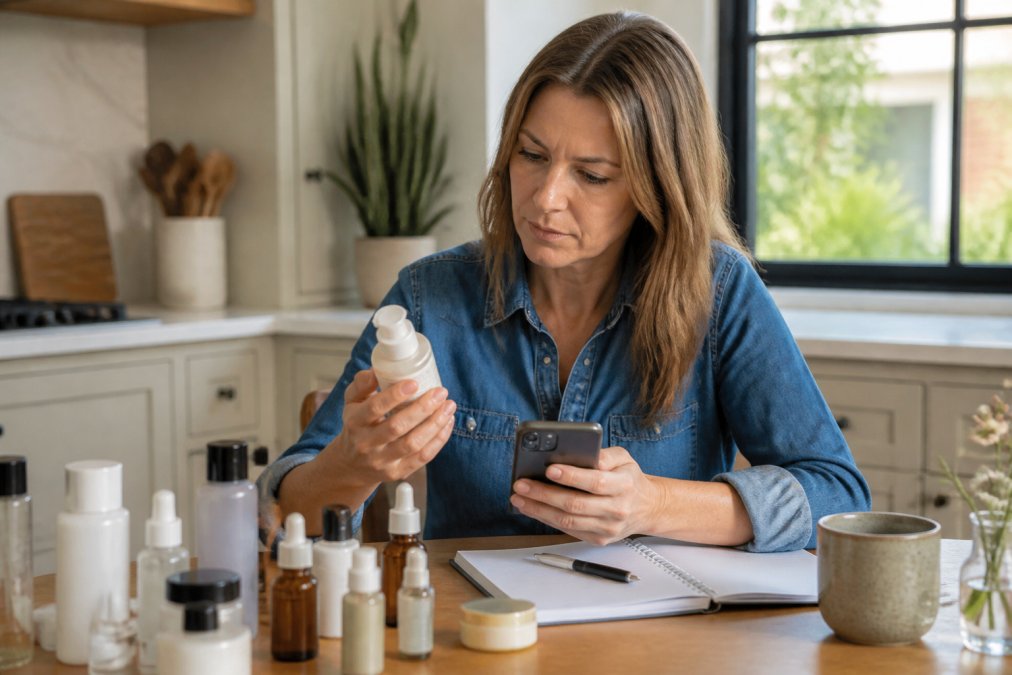
A good rule of thumb: if the ingredient a brand uses to sell the product appears near the bottom of the INCI list, the marketing claim is not supported by the formulation. Concentration levels matter, and ingredient efficacy depends on active ingredients being present in meaningful amounts.
Your Step-by-Step DIY Verification Workflow
Verifying a product at home takes about ten minutes once you know the workflow, and it does not require a chemistry degree. This DIY verification process combines label reading, database checking, and a healthy dose of skepticism about marketing language.
Step 1: Read the full INCI list, not the highlights. Ignore the front of the bottle entirely. Find the ingredient deck and read every entry, including the preservatives at the end.
Step 2: Identify the first five ingredients. These represent the majority of the formula by weight. If the first ingredient is water and the next three are synthetic emollients, the "natural" botanical claim is marketing hype.
Step 3: Verify the hero ingredient's position. Find the ingredient the brand markets most heavily. If it appears after the fifth position, it is likely present at a concentration too low to deliver the promised effect.
Step 4: Check each ingredient in a database. Use a skincare ingredient checker to look up the function and safety profile of the first five ingredients plus the hero ingredient. Look for known irritants, allergen profiles, and whether the ingredient is plant-derived or synthetic.
Step 5: Assess the preservative system. Natural products still need preservatives to prevent microbial growth and maintain shelf-life stability. A formula that relies on a strong, clearly disclosed preservative system is more trustworthy than one that vaguely claims to be "preservative-free."
Step 6: Compare the claims against the evidence. Ask yourself whether the ingredient list supports what the brand promises. A firming cream that contains no peptides, retinol, or other clinically relevant actives cannot deliver firming results, regardless of what the marketing copy says.
This workflow works because it shifts your focus from what the brand says to what the formula actually contains. Regulatory compliance with FDA labeling rules ensures the ingredient list is present and accurate, but it does not tell you whether the product delivers on its promises. That verification is up to you, and now you have the tools to do it.
At Ageless Glow, we build our formulas around nutrient-rich ingredients like turmeric and kojic acid, and we list them clearly so you can see exactly what you are applying. Products like our Lemon Turmeric Soap Bar and Turmeric Face Cream are designed to be transparent about what goes into them and what they can realistically do for your skin.


Conclusion
The gap between what skincare brands claim and what their formulas actually deliver is wider than most shoppers realize, and closing that gap requires a shift in how you evaluate products. By learning to read the INCI list, understanding the limits of FDA cosmetic labeling regulations, and spotting greenwashing tactics, you can make purchasing decisions based on evidence rather than marketing hype.
The verification workflow we have outlined takes ten minutes per product and gives you lasting confidence in what you put on your skin. When you do find a brand that passes the test, one that lists its ingredients honestly and backs its claims with real formulation, that is a brand worth sticking with.
Get started with Ageless Glow and experience skincare where the ingredient list matches the promise.
Frequently Asked Questions
Is there a free skincare ingredient checker app I can use?
Yes, several free apps and websites function as an ingredient checker. The Environmental Working Group's Skin Deep database and the Think Dirty app are popular starting points. These tools let you search for a product or scan its barcode to see an ingredient breakdown and hazard scores. Keep in mind they are screening tools, not definitive safety verdicts. Use them to flag ingredients you want to research further, then make your final call based on your own skin's needs and sensitivities.
How does the FDA regulate 'natural' claims on skincare labels?
The FDA does not define the term 'natural' for cosmetics, so brands use it loosely. Under FDA cosmetic labeling regulations, a product is adulterated if it contains a poisonous or deleterious substance that may injure users. However, the agency does not pre-approve cosmetics or their ingredient claims before they go to market. This means you must be a critical shopper. The FDA can take action against false or misleading claims, but the burden of initial verification falls on you, the consumer.
What are the top 5 ingredients to avoid in skincare products?
Common ingredients many people choose to avoid include parabens (preservatives), phthalates (often in fragrances), formaldehyde releasers (preservatives like DMDM hydantoin), sulfates (SLS/SLES), and synthetic fragrances. This is not a medical warning list, but a starting point for your own research. Check the INCI list on any product and use a skincare ingredient checker to understand what each component does. Your skin's reaction is the final test: patch test new products and stop using anything that causes irritation.
How can I tell if a 'natural' claim is just marketing hype?
Look past the front of the bottle and read the full INCI list. A product can claim to be 'natural' if it contains even a small amount of a plant extract, while the rest is synthetic. Check the order of ingredients: they are listed by concentration. If a natural ingredient is near the end of the list, the product contains very little of it. Question vague terms like 'naturally derived' without specifics, and look for third-party certifications to confirm a brand's sourcing standards.
This article was written using GrandRanker