

Table of Contents
- How Non-Invasive Skin Tightening at Home Actually Works
- Radio Frequency Skin Tightening at Home: What to Expect
- Best At-Home Skin Tightening Device Reviews: What Matters Most
- Safety of At-Home Beauty Devices: What You Need to Know
- Who Is a Good Candidate for At-Home Skin Tightening?
- Step-by-Step Maintenance Protocol for Lasting Results
- Cost Considerations for Non-Invasive Skin Tightening at Home
- Conclusion
Last Updated: August 15, 2026
How Non-Invasive Skin Tightening at Home Actually Works
Non-invasive skin tightening at home is the practice of using energy-based devices or targeted topical treatments to stimulate collagen production and improve skin firmness without surgery, needles, or clinical downtime.
The core mechanism is simple: controlled energy, applied consistently, encourages your skin to repair and rebuild from within. What changes with age is your skin's ability to do that naturally. Below, we break down exactly what's happening at the cellular level and why the right device or formula can genuinely shift that trajectory.
Collagen, Elastin, and Why Skin Loosens Over Time
Collagen is the structural protein that gives skin its firmness and volume. Elastin fibers are the spring-like proteins responsible for skin elasticity, allowing the skin to snap back after movement. Both decline with age, accelerated by UV exposure, hormonal changes, and environmental stressors.
As the dermal layer thins and elastin fibers degrade, skin laxity becomes visible, most noticeably at the jawline, neck, and around the eyes. This isn't a cosmetic inconvenience. It's a structural shift in the subcutaneous tissue that topical products alone cannot fully reverse. That's where energy-based treatments come in.
The Technologies Behind At-Home Devices
Three primary technologies power non-invasive skin tightening at home:
- Radiofrequency energy: Delivers thermal energy into the dermal layer, heating tissue to stimulate collagen remodeling
- Ultrasound technology: Uses focused sound waves to reach deeper tissue layers, triggering a healing response
- Microcurrent: Delivers low-level electrical current to tone facial muscles and support skin texture
Each works differently, and none produces overnight results. The honest truth is that at-home versions of these technologies operate at lower energy levels than clinical equipment, which affects both the speed and magnitude of results.
Radio Frequency Skin Tightening at Home: What to Expect
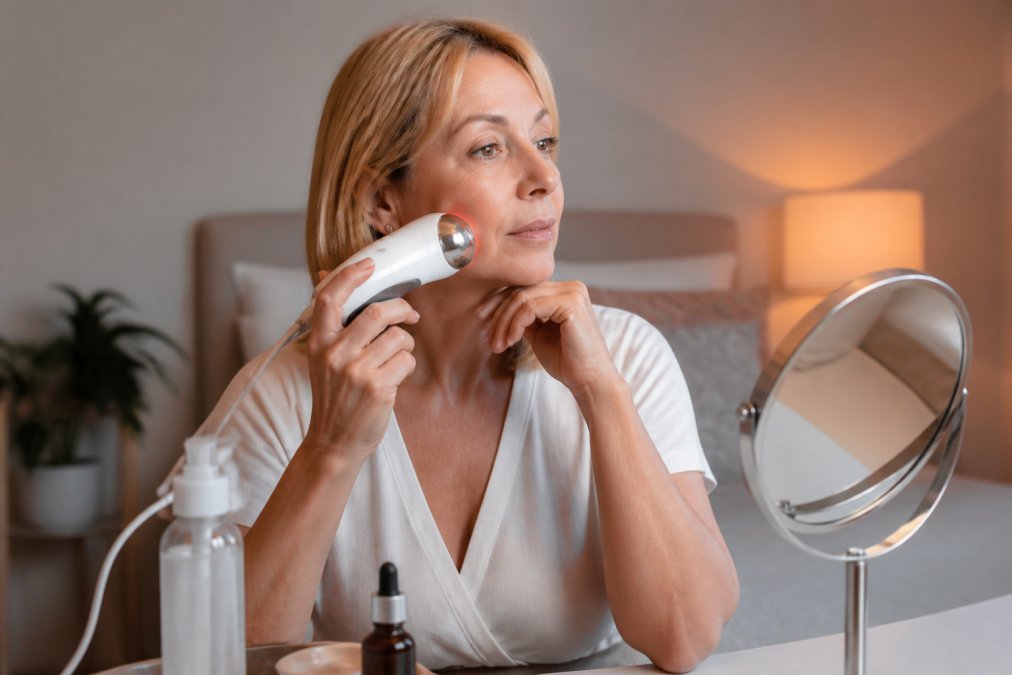
Radio frequency skin tightening at home works by delivering controlled radiofrequency energy through the epidermis into the dermal layer, where it generates heat that triggers the body's natural collagen production response. For many users, it's the most accessible entry point into energy-based facial rejuvenation.
How RF Devices Heat the Dermal Layer
Most at-home RF devices use a conductive gel applied to clean skin before treatment. The device glides across the surface, emitting radiofrequency energy that penetrates the epidermis without damaging the skin barrier. The heat generated in the dermal layer is what does the work: it causes existing collagen fibers to contract while stimulating new collagen production over time.
The sensation is typically described as a warm pressure, not pain. Most sessions last 10 to 20 minutes, and the skin may appear slightly flushed afterward. That redness resolves within an hour for most users, which is why this is genuinely a no-downtime, non-surgical option for people with active schedules.
Realistic Results vs. Marketing Claims
This is the part most guides skip over, and it matters.
At-home RF devices are not clinical machines. In-office radiofrequency treatments use energy levels that are simply not available in consumer devices for safety reasons. What at-home devices can realistically deliver is gradual improvement in skin firmness, fine lines, and skin texture with consistent use over several months.
The American Academy of Dermatology guidance on skin tightening procedures notes that results from non-invasive treatments are typically subtle and cumulative, not dramatic or immediate. Setting realistic expectations from the start is the difference between feeling encouraged by progress and feeling disappointed by the gap between marketing and reality.
Many users report visible improvement in skin firmness after 8 to 12 weeks of consistent use. Some see changes earlier. Deep skin laxity, the kind that develops over decades, responds more slowly and may benefit from professional treatments alongside an at-home protocol.
Best At-Home Skin Tightening Device Reviews: What Matters Most
The biggest mistake people make when shopping for at-home skin tightening devices is buying based on marketing language rather than technology specs and clinical evidence. FDA clearance, treatment depth, and energy output are what separate genuinely effective devices from expensive novelties.
RF Devices
RF devices remain the most widely used at-home option for skin tightening. The best ones are FDA cleared, include adjustable intensity settings, and pair with a conductive gel for optimal energy delivery. Look for devices that specify treatment temperature ranges and have built-in safety cutoffs to prevent overheating.
What most reviews miss: the handpiece design matters as much as the technology. Devices with larger treatment surfaces cover more area per session but may be less precise around contours like the jawline and under-eye area. Smaller handpieces offer more control but require longer sessions.
Ultrasound and Microcurrent Devices
Ultrasound technology at the consumer level uses lower-intensity focused sound waves compared to clinical devices like those used in professional facial rejuvenation treatments. The advantage is depth: ultrasound can reach subcutaneous tissue that RF sometimes doesn't penetrate as effectively. The tradeoff is that at-home ultrasound devices tend to require longer commitment periods before results become visible.
Microcurrent devices work differently. Rather than heat-based therapy, they deliver low-level electrical current to stimulate facial muscles and support collagen production at a more superficial level. They're excellent for improving skin texture and maintaining tone, particularly around the eyes and brow area.
At-Home vs. In-Office Treatments: Honest Comparison
| Treatment Type | Energy Level | Downtime | Results Timeline | Session Cost |
|---|---|---|---|---|
| At-home RF device | Consumer-grade | None | 8-16 weeks | Device purchase only |
| At-home microcurrent | Low-level | None | 6-12 weeks | Device purchase only |
| In-office RF | Clinical-grade | Minimal | 4-8 weeks | Per-session fee |
| In-office ultrasound | High-intensity | 1-3 days | 3-6 months | Per-session fee |
The honest comparison: in-office treatments produce faster and more pronounced results because the energy levels are significantly higher. At-home devices are better understood as a maintenance and prevention tool, or as a complement to occasional professional treatments, rather than a direct replacement.
Safety of At-Home Beauty Devices: What You Need to Know
The safety of at-home beauty devices is a legitimate concern, and it deserves more than a reassuring paragraph. According to FDA consumer guidance on at-home light and energy devices, many at-home energy devices are classified as cosmetic devices and are subject to different regulatory oversight than medical devices. Understanding that distinction helps you shop more carefully.
Contraindications and Medical Warnings
Not everyone is a candidate for at-home skin tightening devices. The following conditions are generally considered contraindications:
- Active skin infections, open wounds, or inflamed acne in the treatment area
- Implanted electronic devices such as pacemakers or defibrillators (RF devices in particular)
- Metal implants, plates, or pins in the face or neck
- Active cancer or history of skin cancer in the treatment area
- Pregnancy
- Epilepsy or seizure disorders (for microcurrent devices)
- Severe skin conditions such as rosacea, eczema, or psoriasis in active flare
If you have any of these conditions, consult a dermatologist before using any energy-based device at home. This is not a disclaimer. It's practical patient safety advice that device marketing rarely emphasizes clearly.
Common Side Effects and How to Minimize Them
The most common side effects from at-home RF and ultrasound devices are temporary redness, mild swelling, and tingling. These typically resolve within a few hours. More serious side effects, including burns or blistering, occur almost exclusively when devices are used incorrectly: too high an intensity setting, too long in one spot, or without conductive gel.
To minimize risk:
- Start at the lowest intensity setting and increase gradually over several sessions
- Keep the device moving; never hold it stationary on one area
- Apply conductive gel generously before each session
- Avoid treating sunburned, irritated, or compromised skin
- Follow the manufacturer's recommended treatment frequency exactly
Who Is a Good Candidate for At-Home Skin Tightening?
At-home skin tightening works best for people with mild to moderate skin laxity who want to maintain or gradually improve skin firmness without clinical procedures. The ideal candidate is typically someone in their 30s to 60s who is beginning to notice fine lines, mild sagging, or a loss of skin elasticity, but whose skin laxity has not yet progressed to the point where only surgical intervention would produce meaningful results.
People with very deep skin laxity, significant jowling, or substantial volume loss are less likely to see satisfying results from at-home devices alone. That doesn't mean devices offer no benefit, but it does mean expectations need to be calibrated honestly.
Age alone is not a disqualifier. Many women in their 60s and beyond see real improvement from consistent at-home protocols, particularly when combined with supportive skincare. What matters more than age is the degree of skin laxity and consistency of use.
Step-by-Step Maintenance Protocol for Lasting Results
Consistent application is the single biggest predictor of results with at-home skin tightening. A protocol that is realistic for your schedule will always outperform an aggressive one you abandon after three weeks.
Weekly Treatment Schedule
A practical maintenance schedule for most at-home RF devices:
- Sessions per week: 2 to 3 (check your device's specific guidance)
- Session duration: 10 to 20 minutes per area
- Rest days between sessions: At least one full day
- Minimum commitment period: 8 weeks before evaluating results
For microcurrent devices, daily use is generally safe and often recommended by manufacturers, since the energy levels are significantly lower than RF.
Supporting Your Results with the Right Skincare
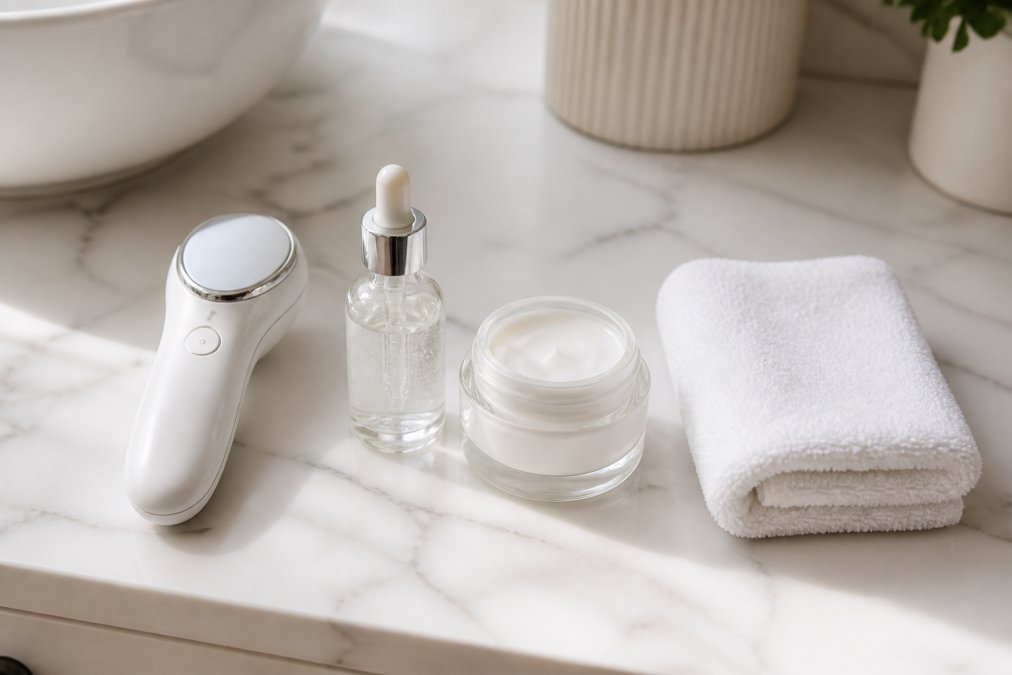
Energy-based treatments stimulate collagen production, but the raw materials for collagen synthesis come from your skincare and nutrition. A targeted skincare routine amplifies what your device is doing.
Prioritize:
- Vitamin C serums applied in the morning to support collagen synthesis and address uneven skin texture
- Retinoids used at night to accelerate cellular turnover and support the dermal layer
- Peptide-rich moisturizers to reinforce the skin barrier and support elastin fiber health
- Broad-spectrum SPF every morning without exception. UV exposure is the leading environmental cause of collagen degradation
Ageless Glow offers nutrient-rich skincare formulas that can work alongside facial devices, delivering targeted ingredients that support the collagen-building process your device initiates. Pairing the right topical application with consistent device use is where most users see the clearest, most lasting improvement.
Cost Considerations for Non-Invasive Skin Tightening at Home
The cost of non-invasive skin tightening at home varies considerably based on the technology and device quality. As a general framework, at-home devices represent a one-time investment rather than an ongoing per-session cost, which is one of their primary advantages over clinical treatments.
Entry-level microcurrent and RF devices sit at the lower end of the market. Mid-range devices with FDA clearance, adjustable settings, and better build quality cost more but tend to deliver more consistent results. Professional-grade consumer devices, which approach the energy output limits allowed for home use, represent the upper end.
For current pricing on Ageless Glow's range of facial devices and skincare sets, visit the Ageless Glow website directly. Prices reflect the quality of technology and formulation, and the team can help match you with the right product for your specific skin concerns.
For context on what clinical alternatives cost, the American Society of Plastic Surgeons annual statistics on cosmetic procedures publishes average costs for in-office non-surgical treatments annually. Comparing those figures against a quality at-home device makes the value case for consistent home use clear.
Frequently Asked Questions
Do at-home skin tightening devices actually work?
At-home devices can produce visible improvements in skin firmness and fine lines when used consistently, but results are more gradual than in-office treatments. Devices cleared by the FDA deliver controlled radiofrequency energy or ultrasound technology to stimulate collagen production in the dermal layer. Most users notice a modest improvement in skin laxity after 8 to 12 weeks of regular use. They are not a substitute for clinical procedures, but they are a practical option for maintenance and prevention.
How often should you use a radio frequency device at home?
Most at-home radio frequency skin tightening devices are designed for use two to three times per week, though treatment frequency varies by device and manufacturer guidelines. Overuse can irritate the skin barrier and cause temporary redness. Starting with one session per week and gradually increasing is a sensible approach, especially for sensitive skin. Always apply a conductive gel before each session and follow the specific protocol included with your device to protect patient safety.
Are at-home skin tightening devices FDA-cleared?
Many reputable at-home skin tightening devices sold in the United States carry FDA clearance, which means the agency has reviewed safety and performance data before allowing them on the market. FDA clearance is not the same as FDA approval, but it is a meaningful benchmark for a cosmetic procedure device. When evaluating any device, check the product listing or manufacturer website for FDA clearance documentation. Devices without this designation carry higher uncertainty around patient safety and clinical efficacy.
What are the risks of using DIY skin tightening tools?
The main risks include burns, temporary redness, and skin irritation from improper use or too-high intensity settings. People with pacemakers, metal implants, active acne, rosacea, or pregnancy should avoid most heat-based therapy devices entirely. Using a device without conductive gel or on broken skin increases the chance of adverse reactions. Sticking to FDA-cleared devices, reading contraindication warnings carefully, and starting at the lowest setting significantly reduces these risks for most healthy adults.
Skin laxity and fine lines don't reverse overnight, regardless of what the marketing says. The real challenge is finding a protocol you'll actually stick with long enough to see cumulative results. Ageless Glow's range of facial devices and nutrient-rich skincare formulas is built for exactly that: visible, lasting improvement through consistent, targeted care. Explore the collection and find the right combination for your skin goals.
This article was written using GrandRanker