

Table of Contents
- How Menopause and Perimenopause Change Your Skin
- Best Natural Ingredients for Menopausal Skin
- How to Treat Dry Skin During Menopause
- Skincare Routine for Perimenopause: Morning and Night Steps
- Building Your Natural Skincare Routine for Menopause
- HRT vs. Topical Skincare: What to Know
- Ingredient Interactions and Contraindications
- Budget-Friendly Natural Alternatives
- Frequently Asked Questions
Last Updated: September 15, 2026
How Menopause and Perimenopause Change Your Skin
Menopause, typically occurring between ages 45 and 55, marks the end of a woman's reproductive years (the NIH). Declining estrogen triggers measurable changes in skin structure, moisture retention, and elasticity. This guide from Ageless Glow explains how to build a natural skincare routine for menopause that addresses these shifts directly.
Estrogen Depletion and Collagen Loss
Estrogen depletion is the primary driver of visible skin aging during menopause. Estrogen supports collagen production, skin elasticity, and dermal thickness (pubmed.ncbi.nlm.nih.gov). When levels drop, collagen synthesis slows and existing collagen breaks down faster than the body replaces it, causing thinner skin, fine lines, and loss of firmness along the jawline and cheeks.
Barrier Function and Transepidermal Water Loss
The skin's barrier function weakens as estrogen declines, allowing more moisture to escape through transepidermal water loss. Your lipid barrier retains water less efficiently, so skin feels tight, looks dull, and reacts to products that never caused problems before, which is why a routine that worked at 40 often stops working at 50.
Best Natural Ingredients for Menopausal Skin
The best natural ingredients for menopausal skin support collagen production, reinforce the lipid barrier, and hydrate deeply without irritation. Look for phytoestrogens, omega fatty acids, ceramides, and antioxidant-rich botanicals.
Phytoestrogens and Botanical Extracts
Phytoestrogens are plant compounds that mildly mimic estrogen's effects on skin. Extracts like soy isoflavones and red clover may support elasticity without the intensity of prescription treatments.
Omega Fatty Acids and Antioxidant-Rich Oils
Omega fatty acids in rosehip oil and flaxseed restore the lipid barrier and reduce inflammation, while antioxidant-rich oils like sea buckthorn and pomegranate seed protect against environmental damage. Hyaluronic acid pairs well with these to attract and retain moisture in deeper layers.

How to Treat Dry Skin During Menopause
Treating dry skin during menopause requires two strategies: gentle cleansing that preserves the barrier, and layered hydration that addresses moisture loss at multiple depths.
Gentle Cleansing and Lipid Barrier Repair
A common mistake is using foaming or exfoliating cleansers that leave skin feeling "squeaky clean", that sensation signals barrier damage. Switch to cream or oil-based cleansers, and exfoliate once or twice weekly with a mild acid, not a scrub, to support turnover without micro-tears.
Hydration and Moisturization Strategies
Hydration and moisturization are not the same thing, and menopausal skin needs both. Hydration adds water through humectants like hyaluronic acid; moisturization seals it in with emollients and occlusives like ceramides and shea butter. Apply a hydrating serum first, then a richer moisturizer.
| Concern | Ingredient Type | How It Helps | When to Apply |
|---|---|---|---|
| Dryness and tightness | Humectants (hyaluronic acid) | Attract water into skin | Morning and night |
| Barrier damage | Ceramides and fatty acids | Rebuild lipid barrier | Night |
| Dullness | Antioxidant-rich oils | Protect and brighten | Morning |
| Fine lines | Phytoestrogens | Support elasticity | Night |
Skincare Routine for Perimenopause: Morning and Night Steps
A skincare routine for perimenopause should protect during the day and repair at night. Perimenopause brings unpredictable hormonal fluctuations that shift skin sensitivity and oiliness week to week.
Morning Routine for Protection
Start with a gentle cream cleanser, then a hydrating serum with hyaluronic acid. Follow with a ceramide moisturizer and broad-spectrum mineral SPF of at least 30. Mineral SPF sits on top of skin rather than absorbing, so it's less likely to irritate reactive skin (the American Academy of Dermatology).
Nighttime Repair and Recovery
At night, cleanse again and apply a retinol alternative if your skin tolerates it. Bakuchiol, a plant-derived compound, offers retinol-like benefits with less irritation, important for menopausal skin. Layer a firming serum under a richer night cream to support overnight recovery.
Building Your Natural Skincare Routine for Menopause
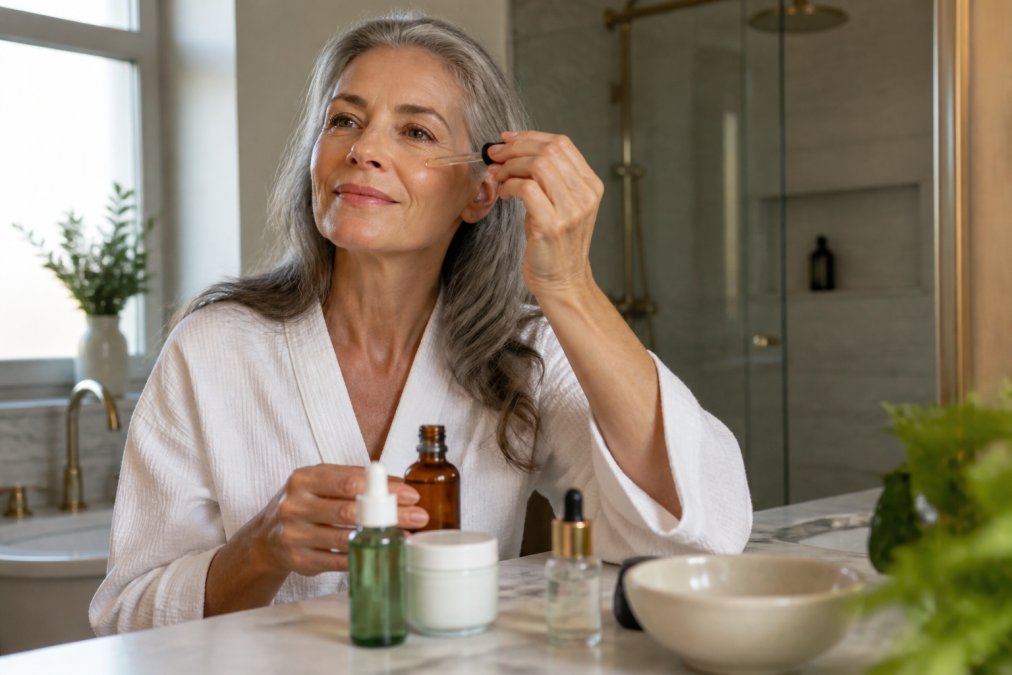
Building your natural skincare routine for menopause comes down to consistency and simplicity. A four-step routine you follow daily outperforms a ten-step routine you abandon after two weeks.
Start with these core steps:
- Cleanse gently with a cream or oil-based formula
- Hydrate with a hyaluronic acid serum on damp skin
- Moisturize with a ceramide-rich cream to seal in water
- Protect every morning with broad-spectrum mineral SPF
For women who want a complete, coordinated approach, Ageless Glow offers a Full-Size Korean Skincare Set that covers morning and night steps in one package, including a hyper serum for both AM and PM use. Pair it with the Hyaluronic Acid & Niacinamide Hydrating Serum for deeper moisture retention, or add the Firming Facial Serum if loss of firmness is your main concern.


HRT vs. Topical Skincare: What to Know
Most guides either promote a full topical routine or defer entirely to a doctor, and neither answers the question women actually search: if I am on hormone therapy, do I still need a natural skincare routine, and if I am not, what can topicals realistically do? These approaches work on different layers of the same problem, and understanding the boundary is what makes either one effective.
How the Two Mechanisms Differ
Systemic hormone therapy, delivered as a pill, patch, gel, or spray, raises circulating estrogen throughout the body. Because estrogen receptors exist in skin fibroblasts, restoring systemic estrogen can support collagen synthesis, dermal thickness, and moisture retention from the inside, a body-wide effect, not a surface one.
Topical skincare never reaches the bloodstream in meaningful amounts. It works in the stratum corneum and, for some actives, the upper epidermis, so a serum can reinforce the lipid barrier, hold water, calm inflammation, and deliver antioxidants, but it cannot rebuild dermal collagen the way systemic estrogen can.
A useful way to hold the distinction:
- Systemic therapy addresses the cause, the estrogen decline driving collagen loss and barrier weakening.
- Topical routines address the consequences, the dryness, reactivity, dullness, and fine lines that result.
- Neither replaces the other. A woman on hormone therapy still has surface damage from years of UV exposure and barrier stress. A woman not on hormone therapy can still meaningfully improve barrier function and hydration with topicals.
What Topicals Can and Cannot Do
| Goal | Systemic HRT | Topical Routine |
|---|---|---|
| Restore dermal collagen | Yes, body-wide | No, supports surface only |
| Increase skin thickness | Yes | Limited |
| Reduce transepidermal water loss | Indirectly | Yes, directly via ceramides and occlusives |
| Calm reactivity and redness | Indirectly | Yes, via barrier repair and anti-inflammatories |
| Address UV-driven damage | No | Yes, via antioxidants and daily SPF |
If You Are Considering Hormone Therapy
Hormone therapy carries real risks and benefits that depend on your health history, formulation, delivery method, and how long you have been post-menopausal, medical decisions for a clinician who knows your chart. What a skincare article can tell you is that starting hormone therapy is not a reason to abandon your topical routine, and stopping it is not a reason to give up on your skin.
If You Are Not on Hormone Therapy
This is where a natural routine earns its keep.
The Practical Takeaway
Ingredient Interactions and Contraindications
Why Interactions Matter More Now
Combinations to Separate
Combinations That Are Fine, With Caveats
Essential Oils and Sensitive Skin
A Simple Sequencing Rule
Budget-Friendly Natural Alternatives
Frequently Asked Questions
How does menopause affect skin health?
Menopause causes estrogen depletion, which reduces collagen production and weakens the skin's barrier function. This leads to dermal thinning, increased transepidermal water loss, and loss of skin elasticity. Many women notice dryness, fine lines, and dullness. A natural skincare routine for menopause can help address these changes by using ingredients like hyaluronic acid, ceramides, and phytoestrogens to support hydration and barrier repair.
What are the best natural ingredients for menopausal skin?
Look for phytoestrogens (e.g., soy, red clover), omega fatty acids (flaxseed, evening primrose), rosehip oil, aloe vera, hyaluronic acid, and ceramides. These ingredients help boost hydration, support collagen production, and soothe inflammation. Antioxidant-rich botanical extracts like green tea and chamomile also protect against environmental damage. Incorporate them into a gentle, consistent routine for best results.
How do I treat dry skin during menopause?
Treat dry skin during menopause by switching to a gentle, non-comedogenic cleanser, applying a hyaluronic acid serum to damp skin, and sealing with a rich moisturizer containing ceramides or omega fatty acids. Avoid hot water and harsh exfoliants. Use a broad-spectrum mineral SPF daily. For severe dryness, consider adding a facial oil like rosehip or argan oil at night to support the lipid barrier.
Can natural skincare help with menopausal acne?
Yes, natural skincare can help with menopausal acne by using anti-inflammatory botanical extracts like tea tree, aloe vera, and green tea. Gentle exfoliation with fruit enzymes or salicylic acid from natural sources (e.g., willow bark) can unclog pores without stripping skin. Avoid heavy oils that may clog pores. A consistent routine that balances hydration and gentle exfoliation can reduce breakouts.