

Table of Contents
- What Defines Professional Skincare and How It Differs
- Medical-Grade Skincare vs Drugstore: Key Differences in Efficacy
- The Real Cost of Professional Skincare: ROI and Long-Term Value
- How to Build a Professional Skincare Routine That Works
- When Professional Skincare Delivers Results vs. When It Doesn't
- Common Myths About Professional Skincare Worth and Effectiveness
- Making the Investment: A Framework for Deciding If It's Right for You
Last Updated: August 19, 2026
What Defines Professional Skincare and How It Differs
Professional skincare refers to products formulated with higher concentrations of active ingredients than over-the-counter alternatives, typically requiring application by a dermatologist, esthetician, or skincare specialist. Professional-grade formulations penetrate deeper into the skin and deliver measurable results for specific concerns like fine lines, hyperpigmentation, and loss of elasticity.

The core difference comes down to ingredient potency, formulation stability, and personalization. Professional products contain retinoids, peptides, and antioxidants at concentrations requiring professional guidance to use safely. Drugstore products, while sometimes effective for maintenance, contain lower concentrations designed for broader consumer use without specialist oversight.
Professional skincare isn't automatically superior, it's superior when your skin concern matches what the formulation addresses. A person with mild dryness might see results from a quality drugstore moisturizer. Someone with deep lines, uneven texture, or significant sun damage often needs the concentrated actives found in professional formulations. The investment question hinges on whether the higher cost produces results your skin actually needs.
Medical-Grade Skincare vs Drugstore: Key Differences in Efficacy
Medical-grade skincare products contain clinical-strength active ingredients at concentrations proven in dermatological studies to produce measurable changes. Drugstore products, while regulated for safety, contain lower concentrations designed for general maintenance rather than clinical intervention.
The efficacy gap exists because of bioavailability, how effectively an ingredient penetrates the skin barrier and reaches cells where it can work. Medical-grade formulations use stabilization systems, molecular weight adjustments, and pH balancing to maximize bioavailability. A drugstore retinol might sit on the surface; a professional retinoid formulation penetrates to the dermal layer where it stimulates collagen production.
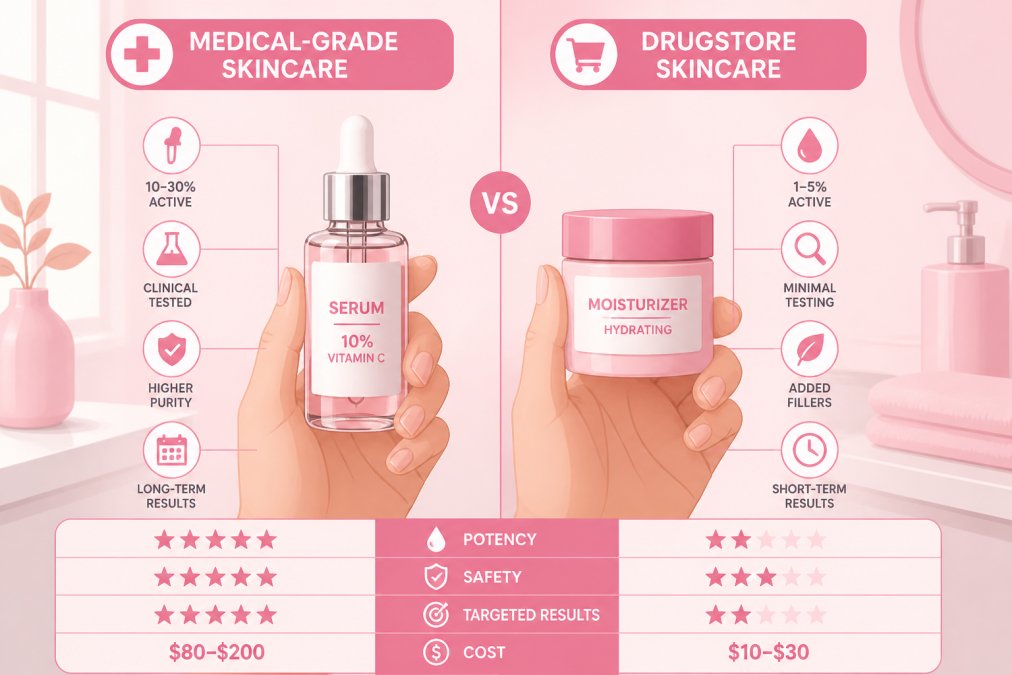
Consider ingredient concentration. A professional-grade vitamin C serum might contain 15-20% L-ascorbic acid, while drugstore versions often contain 5% or less. Studies show concentration thresholds exist below which an ingredient produces minimal visible benefit. The same applies to retinoids, hyaluronic acid penetration depth, and peptide formulations.
Formulation stability also separates the two tiers. Professional products often use airless packaging, stabilized pH systems, and preservative technology that maintains ingredient efficacy over months of use. Many drugstore products degrade faster, especially when exposed to light and air. Professional skincare lines typically conduct stability testing, penetration studies, and efficacy trials more consistently than drugstore brands.
The Real Cost of Professional Skincare: ROI and Long-Term Value
Professional skincare costs more upfront, but the ROI calculation requires looking beyond price per ounce. A $150 serum used twice daily lasts roughly 60 days, $2.50 per application. A $30 drugstore serum costs $0.50 per application, but if it produces no visible results after three months, the actual cost per unit of benefit is infinite.
Long-term value depends on efficacy, longevity of results, and whether you're treating or maintaining. Professional skincare excels at treating specific concerns. Once you've addressed deep lines or significant hyperpigmentation, maintenance becomes cheaper. Many people transition to lower-cost products after achieving results with professional formulations.
Professional skincare often requires less product per application because concentration is higher. You use less, it lasts longer, and you see results faster. A professional retinoid might show visible improvement in 8-12 weeks, while a drugstore alternative might take six months or produce no noticeable change.
Consider the cost of alternatives. Professional treatments like laser resurfacing, chemical peels, or injectables range from $200 to $3,000 per session. If professional-grade skincare delays or prevents the need for these treatments, the ROI becomes obvious. Spending $100-200 monthly on effective products is significantly cheaper than professional procedures.
Ageless Glow's Full-Size Korean Skincare Set for Dark Spots, Fine Lines & Glass Skin at $170.94 combines multiple professional-grade actives in a complete routine, removing guesswork and ensuring complementary formulations.

How to Build a Professional Skincare Routine That Works
A professional skincare routine succeeds when it matches your specific skin type, primary concern, and tolerance for active ingredients. Professional routines are built in layers, with each product serving a specific function.
Start with skin type assessment. Professional estheticians evaluate skin using categories: oily, dry, combination, sensitive, or normal. Your type determines which actives you tolerate and how frequently you can use them.

Next, identify your primary concern. Are you treating fine lines, hyperpigmentation, loss of firmness, texture irregularities, or dehydration? Professional routines stack ingredients addressing this specific issue.
The basic structure follows this order: cleanse, treat, hydrate, protect. Cleansing removes barriers preventing active ingredients from penetrating. Treatment products contain concentrated actives. Hydrating layers lock in moisture and support the skin barrier. SPF protects against further damage.
Common mistake: adding too many actives at once. Retinoids, vitamin C, niacinamide, and acids all work, but combining them immediately causes irritation and barrier damage. Introduce one active at a time, wait 2-4 weeks for tolerance, then layer additional products. Frequency matters as much as product selection. A professional retinoid might be used 2-3 times weekly initially, increasing to nightly as tolerance builds.
When Professional Skincare Delivers Results vs. When It Doesn't
Professional skincare delivers measurable results when three conditions align: the product targets your specific concern, your skin tolerates the active ingredients, and you use it consistently for long enough to see change.
Results appear fastest for dehydration and mild dullness, often within days. Fine lines and hyperpigmentation take 8-12 weeks of consistent use. Loss of firmness and deep wrinkles might require 4-6 months or combination with professional treatments.
Professional skincare fails when expectations don't match reality. No topical product eliminates deep wrinkles completely. Professional skincare improves appearance, softens lines, and prevents further damage, but it's not a substitute for procedures if you want dramatic change.
Skin barrier health determines whether you'll tolerate professional actives. Compromised barriers react poorly to concentrated ingredients. If your skin barrier is damaged, barrier repair might need to come first.
Ingredient interactions matter. Vitamin C and retinoids together can be irritating initially but become powerful when tolerance builds. Niacinamide and hyaluronic acid work beautifully together. Professional routines account for these interactions.
The Zero Exosome Spicule Shot from Ageless Glow ($143.99) combines deep-pore clarification with hydration and smoothing in a single formulation, eliminating guesswork of layering incompatible products.
Age and skin history affect outcomes. Someone in their 30s with early prevention goals sees results faster than someone in their 60s with decades of sun damage.
Common Myths About Professional Skincare Worth and Effectiveness
Myth 1: Professional skincare works immediately. Reality: Visible results typically require 8-12 weeks of consistent use. Hydration improvements might appear within days, but structural changes take weeks.
Myth 2: Higher price always means better results. Reality: Price reflects formulation complexity and research investment, not always efficacy. Some professional products outperform others at the same price point.
Myth 3: Professional skincare works for everyone. Reality: Individual skin variation is massive. Professional skincare requires customization based on your specific needs.
Myth 4: You need professional treatments to see results from professional skincare. Reality: Professional skincare alone produces significant visible improvement for most concerns.
Myth 5: Professional skincare requires daily use of multiple products. Reality: Effective routines are often simple, sometimes just three steps: cleanse, treat, protect. Consistency and ingredient quality matter more than quantity.
Myth 6: Natural or drugstore alternatives work just as well. Reality: Some do for specific concerns. Many don't. The difference is concentration and formulation science. Professional formulations invest in the science that makes ingredients work.
Making the Investment: A Framework for Deciding If It's Right for You
The decision to invest in professional skincare depends on answering four questions honestly.
Question 1: Do you have a specific skin concern that needs addressing? General maintenance doesn't require professional skincare. Professional skincare makes sense when you're treating something, fine lines, hyperpigmentation, loss of firmness, texture issues.
Question 2: Can you commit to consistent use for 8-12 weeks minimum? Professional skincare requires patience. If you abandon routines after three weeks or switch products constantly, the investment won't pay off.
Question 3: Can your skin tolerate active ingredients? Sensitive skin, compromised barriers, and certain medical conditions limit what professional skincare you can use.
Question 4: What's your budget for skincare? Professional products range from $40 to $300+ per item. A complete routine might cost $200-500 monthly initially, then stabilize around $100-200.
| Decision Factor | Professional Skincare Makes Sense | Professional Skincare Might Not |
|---|---|---|
| Skin Concern | Specific issue (lines, spots, firmness) | General maintenance or healthy skin |
| Consistency | Can commit 8-12 weeks minimum | Struggle with routines or switch frequently |
| Skin Sensitivity | Tolerates active ingredients well | Highly sensitive or compromised barrier |
| Budget | $100-300+ monthly available | Limited to $30-50 monthly |
| Age/Skin History | Prevention or early treatment | Severe damage requiring professional procedures |
If three of these factors align with the "makes sense" column, professional skincare is likely worth the investment.
Start with one targeted product rather than a full routine. The Korean Retinol Moisturizing Essence & Exfoliating Eye Cream at $14.99 offers professional-grade actives at an accessible entry point. Use it for 12 weeks, assess results, then expand your routine if you see improvement.

Professional skincare is worth it when the investment produces results your current routine cannot. It's not worth it if you're hoping it will replace professional treatments, if you can't commit to consistent use, or if your skin needs barrier repair before introducing active ingredients.
Professional skincare delivers visible results for specific concerns when you choose formulations matched to your skin type and primary issue. Ageless Glow's curated selection of professional-grade products removes the guesswork of building an effective routine. Start with the Retinol Face Cream at $41.99 or invest in a complete system like the Full-Size Korean Skincare Set to address multiple concerns simultaneously. Give your routine 8-12 weeks of consistent use, and you'll know whether professional skincare is the right investment for your skin.
Frequently Asked Questions
Does professional skincare really make a difference compared to drugstore brands?
Professional skincare delivers measurable differences in three areas: active ingredient concentration (typically 5-10x higher), formulation stability that preserves potency, and clinical-strength actives like prescription-grade retinoids or high-dose vitamin C. Drugstore products often prioritize shelf stability and cost over bioavailability, meaning your skin absorbs less of the active ingredient. Results depend on consistent use and skin type matching, a $15 professional retinol essence will outperform a $50 drugstore moisturizer if your skin needs that specific active.
What is the difference between clinical and over-the-counter skincare?
Clinical skincare contains active ingredients at concentrations proven effective in dermatological studies, typically requiring 8-12 weeks to show visible results. Over-the-counter formulas use lower concentrations for safety and shelf stability, often delivering subtle improvements over months. Professional skincare sits between these: it uses clinical-strength actives (like 0.5-1% retinol) without requiring a prescription. The key difference is penetration depth and dermal absorption; professional products are formulated to reach deeper skin layers where aging and damage occur.
How long does it actually take to see results from professional skincare?
Most professional skincare products require 4-6 weeks of consistent use to show visible changes in fine lines, texture, or brightness. Deeper concerns like significant hyperpigmentation or skin firmness typically take 8-12 weeks. Results depend on your skin barrier function, the specific active ingredient, and whether you're using complementary products (like sunscreen, which amplifies anti-aging results). Starting with lower concentrations and gradually increasing frequency reduces irritation and helps your skin adapt faster.
Is professional skincare worth the investment if I have sensitive skin or deep lines?
Professional skincare is worth it for sensitive skin if you start with gentle, high-concentration hydrating actives like hyaluronic acid or peptides rather than strong exfoliants. For deep lines, professional-grade retinoids and peptide serums deliver better results than drugstore alternatives because they penetrate deeper and maintain stability longer. The investment pays off fastest when you match the product to your specific concern, a targeted serum addressing your exact issue beats a generic moisturizer at any price point. Patch testing before full use minimizes risk.
This article was written using GrandRanker