

Table of Contents
- Understanding Deep Wrinkles Around the Mouth: What You're Actually Dealing With
-
How to Get Rid of Lip Lines Naturally: A Step-by-Step Routine
- The Order of Operations (Thinnest to Thickest)
- Step 1: Cleanse and Prep the Area Gently
- Step 2: Layer Hydration Before Anything Else
- Step 3: Apply Targeted Treatments and Seal With Moisture
- Patch Testing and Introducing Actives Safely
- What Belongs on the Lips vs. the Surrounding Skin
- The Morning Version
- Best Ingredients for Lip Wrinkles: What Works and What's Overhyped
- Does Vaseline Help Lip Wrinkles? Separating Fact From Habit
- How to Reduce Smile Lines Without Injectables
- How Long Until You See Results? Setting Realistic Expectations
- When Natural Care Isn't Enough: Signs You Need Professional Help
- Frequently Asked Questions
Last Updated: October 14, 2026
Understanding Deep Wrinkles Around the Mouth: What You're Actually Dealing With
Deep wrinkles around the mouth are structural skin changes, not the fine lines of your thirties, and that difference shapes everything about how to treat deep wrinkles around mouth naturally. At Ageless Glow, customers often buy a hydrating serum expecting it to erase a fold that has been forming for a decade.

Natural care still helps, it just works more slowly than most product labels admit.
Deep Wrinkles vs. Fine Lines: Why the Difference Matters for Treatment
Fine lines are surface-level: they appear when skin loses hydration and often soften within weeks of moisturizing.
Deep wrinkles are different. They form when collagen and elastin break down below the surface. The Cleveland Clinic overview of facial wrinkles explains that these creases become etched into the skin over years of repeated movement.
That distinction matters because it sets your expectations:
- Fine lines respond well to hydration and gentle exfoliation
- Deep wrinkles need collagen support plus consistent sun protection
- Neither type disappears overnight, no matter what a label claims
What Causes Wrinkles Around the Mouth
Four forces do most of the damage around the mouth.
- Natural aging. Collagen production drops with age, so skin loses its spring.
- Sun exposure. UV light breaks down collagen faster than time alone. This is called photoaging.
- Repetitive movement. Smiling, sipping, and talking fold the same skin thousands of times.
How to Get Rid of Lip Lines Naturally: A Step-by-Step Routine
You can get rid of lip lines naturally with a simple daily routine, but consistency beats intensity.
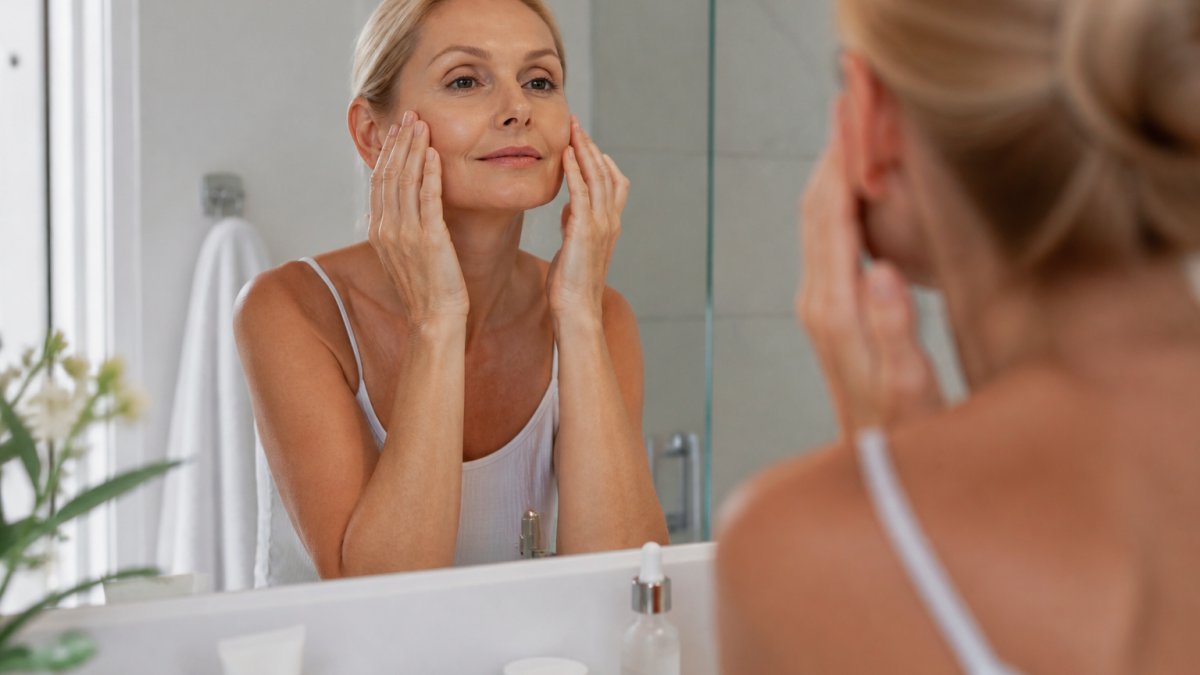
The Order of Operations (Thinnest to Thickest)
Skincare layers go on thinnest to thickest, because a heavy cream applied first blocks everything after it. The sequence for the mouth area is:
- Cleanser
- Hydrating serum (on damp skin)
- Treatment serum or retinol (night only)
- Moisturizer
- Occlusive balm or ointment (optional, night only)
Sunscreen goes last in the morning, after moisturizer. If you use a vitamin C serum, it goes before your hydrating serum in the morning.
Step 1: Cleanse and Prep the Area Gently
Use a mild, fragrance-free cleanser and lukewarm water. Hot water strips the skin barrier around the lips, which is thinner than the rest of your face and has fewer oil glands.
Pat dry with a soft cloth, do not rub. The skin here tears easily, and repeated tugging works against a fold.
Step 2: Layer Hydration Before Anything Else
Apply a hydrating serum to damp skin. Look for hyaluronic acid, which pulls water into the skin and plumps fine lines on contact.
Our Hyaluronic Acid & Niacinamide Hydrating Serum pairs hyaluronic acid with niacinamide to support the barrier and soften fine lines, and it layers well under cream.
Use two to three drops for the whole lower face; excess serum sits on the surface and pills under makeup.
Step 3: Apply Targeted Treatments and Seal With Moisture
This is where most routines stop too early. Hydration plumps. It does not rebuild.
Add a retinol product two or three nights a week, then seal everything with a richer cream overnight. A Retinol Face Cream made for sensitive skin is a reasonable starting point for beginners.

Here is the frequency ramp that keeps most people from quitting:
- Weeks 1 to 2: retinol once every third night
- Weeks 3 to 4: every other night, if there is no stinging or peeling
- Week 5 onward: nightly, or stay at every other night if your skin is sensitive
If you feel a burn when you apply moisturizer, that is a signal to back off, not push through. Drop to the previous frequency for a week.
Patch Testing and Introducing Actives Safely
Before putting retinol near your mouth, patch test it: apply a small amount behind your ear or on your inner forearm, wait 24 hours, and check for redness, itching, or bumps.
Start with a pea-sized amount for the entire face. Dot it on the forehead, cheeks, and chin first, then work the residue lightly toward the mouth area.
What Belongs on the Lips vs. the Surrounding Skin
The lip area is not the same as the skin around it, and treating them identically causes most irritation people blame on retinol.
- On the lips: occlusive balms, petrolatum, lanolin, ceramides, shea butter. Lips have no oil glands and cannot moisturize themselves.
- Around the lips (the vermilion border outward): hydrating serums, niacinamide, peptides, and, once tolerated, retinol.
- Never on the lips: retinol, exfoliating acids, vitamin C serums, and anything with fragrance or essential oils. These sting, dry the lip line, and can make the crease look worse.
The Morning Version
Mornings are about protection, not repair:
- Rinse with lukewarm water or a gentle cleanser
- Vitamin C serum, if you use one
- Hydrating serum
- Moisturizer
- Broad-spectrum sunscreen, SPF 30 or higher, reapplied every two hours outdoors
Sunscreen protects whatever progress the night routine makes; without it, UV exposure breaks down the collagen you are trying to support.
Best Ingredients for Lip Wrinkles: What Works and What's Overhyped
The best ingredients for lip wrinkles fall into three groups: hydrators, collagen supporters, and antioxidants. Everything else is mostly marketing. Here is what each does and where the honest ceiling sits.
Hyaluronic Acid & Niacinamide Hydrating Serum →
Ingredients That Support Collagen and Elasticity
- Retinol and retinoids. The most studied ingredients for smoothing wrinkles over time. They speed up cell turnover and support collagen production. Evidence quality: strong for fine lines and texture, moderate for deep folds. Start low, go slow, and keep it off the lips themselves.
- Peptides. Short chains of amino acids that signal skin to build more collagen. Evidence quality: moderate and formula-dependent. Some peptides have solid lab support; many products use too little to matter.
- Vitamin C. An antioxidant that supports collagen and brightens uneven tone. Evidence quality: strong for antioxidant protection and tone, moderate for wrinkle depth. It is unstable, so packaging matters as much as concentration.
A Firming Facial Serum with vitamin C, E, and hyaluronic acid covers several of these at once. For a gentler daily option, an Anti-Wrinkle Vita C Capsule Cream combines vitamin C with collagen in a light gel formula.

Natural Remedies Worth Trying and Their Honest Limitations
Natural oils, aloe vera, and collagen supplements all have a place, but none rebuild deep folds on their own. The table below separates what each remedy does from what it cannot do.
| Remedy | What It Helps | Mechanism | Honest Limit |
|---|---|---|---|
| Aloe vera | Soothes and hydrates | Humectant; draws water to the surface | No collagen effect; not a substitute for moisturizer |
| Natural oils (jojoba, rosehip, argan) | Locks in moisture | Emollient; slows water loss | Cannot fill deep folds; some oils clog pores |
| Collagen supplements | May support skin over months | Provides amino acids; may signal collagen synthesis | Evidence is mixed; effects are modest and slow |
| Facial massage | Boosts circulation | Increases blood flow and lymphatic drainage | Temporary plumping only; no structural change |
| Vitamin E oil | Antioxidant support | Neutralizes free radicals | Weak evidence for wrinkles; can irritate sensitive skin |
| Honey masks | Hydration and mild antibacterial effect | Humectant; draws water to the surface | No collagen effect; messy and short-lived |
Use these alongside a real routine, not instead of one. A face oil over a hydrating serum is a reasonable seal; on dry skin, it is just a layer of oil on top of a fold.
What the Evidence Actually Says About 'Natural' Wrinkle Treatments
The word natural does not mean effective or safe. Several plant extracts and essential oils cause contact dermatitis, especially on the thin skin around the mouth, citrus oils and peppermint are common culprits.
A useful way to sort any remedy is to ask three questions:
- Does it add water? Humectants like hyaluronic acid, glycerin, and aloe do this.
- Does it stop water loss? Emollients and occlusives like oils, shea butter, and petrolatum do this.
- Does it change skin structure? Only a small number of ingredients, chiefly retinoids, have strong evidence here.
If a remedy only answers question one or two, it can soften the look of a line but will not flatten a deep fold. That is not a reason to skip it.
Does Vaseline Help Lip Wrinkles? Separating Fact From Habit
Vaseline helps lip wrinkles only in one narrow way: it locks in moisture you have already applied.
So it works as the final step of a hydrating routine. It does nothing for collagen loss or deep folds.
Smearing it on dry lips and calling it a treatment misses the point: apply your serum first, then seal it.
How to Reduce Smile Lines Without Injectables
You can reduce smile lines without injectables by combining facial massage, targeted skincare, and daily sun protection. Results are gradual but safe and repeatable.
Facial Exercises and Massage: Do They Actually Work?
Facial exercises and massage give a modest, temporary lift: they boost circulation and can soften fine lines for a few hours.
But massage cannot rebuild collagen, so it will not flatten a deep nasolabial fold. Treat it as a supporting habit, not a cure.
Lifestyle Adjustments That Slow Smile Line Progression
Small daily choices add up more than any single product:
- Wear broad-spectrum sunscreen every day, even indoors near windows
- Aim for 7 to 9 hours of sleep to support skin repair
- Drink enough water to keep skin hydrated from within
How Long Until You See Results? Setting Realistic Expectations
Expect hydration results in one to two weeks and texture changes in eight to twelve weeks. Deep folds may soften over six months or more, and some will never fully disappear with topical care alone.
Here is the honest timeline:
- Week 1 to 2: Skin feels softer and looks plumper
- Week 4 to 8: Fine lines around the mouth look less visible
- Week 8 to 12: Texture and tone improve with consistent retinol use
Anyone promising faster results for deep folds is overselling. The American Academy of Dermatology guidance on wrinkle prevention is clear that sun protection and consistent care matter more than any single product.
When Natural Care Isn't Enough: Signs You Need Professional Help
Natural care has a ceiling, and knowing where it sits saves money and frustration.
Consider professional options if:
- A fold stays deep even when your face is relaxed
- You have lost significant volume around the mouth
- Twelve weeks of consistent care has changed nothing
Dermatologists can discuss dermal fillers, laser treatment, and skin resurfacing. These are not failures of your routine, they address structure that creams cannot reach.
Deep wrinkles around the mouth are stubborn, and no single cream will undo years of collagen loss. At Ageless Glow, we built our anti-aging lineup for exactly this kind of patient, consistent care, from our Hyaluronic Acid & Niacinamide Hydrating Serum to our firming and retinol formulas.
Frequently Asked Questions
What removes wrinkles around the mouth?
No single product removes deep mouth wrinkles, but a consistent routine can soften their appearance. Hydrating serums with hyaluronic acid plump the skin, while retinol creams like the Retinol Face Cream ($41.99) support cell turnover over time. For deeper folds, dermatologists may recommend in-office options such as dermal fillers or laser treatments. Natural care works best as prevention and ongoing maintenance rather than a one-time fix.
Can natural skincare reduce the appearance of deep wrinkles around the mouth?
Natural skincare can improve hydration, skin texture, and firmness, which makes deep wrinkles around the mouth look less pronounced. Ingredients like hyaluronic acid, niacinamide, and vitamin C support the skin barrier and collagen production. Results build gradually, typically over 8 to 12 weeks of daily use. Deep structural folds may still need professional treatment to fully address them.
Does Vaseline help lip wrinkles?
Vaseline locks in moisture and prevents water loss from the skin, which can temporarily smooth the look of fine lip lines. It does not stimulate collagen or elastin production, so it will not reverse deep wrinkles on its own. Using it as an overnight sealant after applying a hydrating serum gives better results than applying it alone. Think of it as a moisture barrier, not a wrinkle treatment.
How long does it take to see a difference from a wrinkle-care routine?
Most people notice improved hydration and smoother skin texture within 2 to 4 weeks. Visible softening of fine lines typically takes 8 to 12 weeks of consistent use. Deep wrinkles around the mouth respond more slowly because they involve structural changes in the skin. Pairing daily hydration with ingredients like retinol or peptides and protecting the area from UV exposure helps you see results faster.