

Table of Contents
- Why Layering Natural Anti-Aging Serums Matters
- The Best Order to Apply Skincare Products: Thinnest to Thickest
- How Long to Wait Between Serum Applications
- Skincare Layering Mistakes to Avoid
- Ingredient Compatibility: What Not to Mix
- Troubleshooting Pilling and Skin Barrier Sensitivity
- Budget-Friendly vs. Luxury Layering
- Frequently Asked Questions
Last Updated: September 10, 2026
Why Layering Natural Anti-Aging Serums Matters
Layering natural anti-aging serums means applying multiple products in a deliberate sequence so each formula absorbs instead of sitting on top of the last one. Get the order right and your products work harder; get it wrong and you're pouring expensive moisture down the drain.
Most people treat their routine as a checklist: cleanse, apply everything, moisturize, done. That wastes product. A serum applied over a thicker formula can't penetrate the skin barrier, so its actives never reach the layers where they work. Many people spend years on serums without visible results.
The fix is simpler than the problem. Below: the exact order, wait times, ingredient combinations that cancel each other out, and how to troubleshoot pilling and irritation.
The Best Order to Apply Skincare Products: Thinnest to Thickest
The golden rule: apply products from thinnest to thickest, starting with the most water-based formula and ending with the most oil-based or anhydrous one. This lets each layer absorb before the next seals it in.
Think of it as a permeability gradient. A watery serum passes through the skin barrier easily. An oil-based cream forms a film on top. If you reverse that order, the oil film blocks everything underneath it.
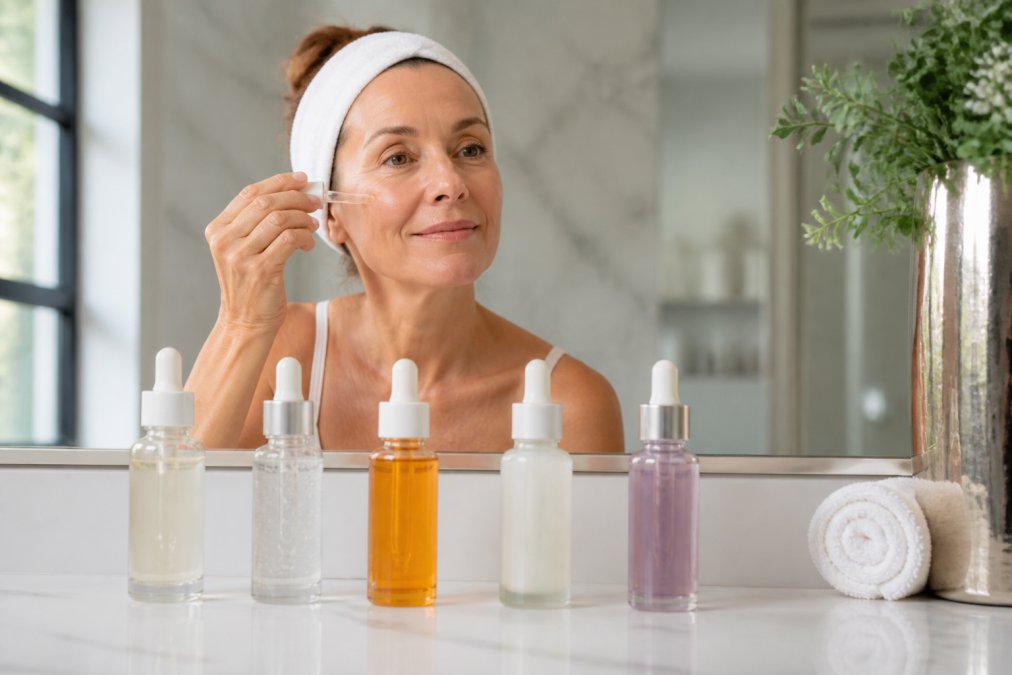
Water-Based Serums First
Water-based serums go on immediately after cleansing, while skin is still slightly damp. Damp skin absorbs faster, and formulas with hyaluronic acid or niacinamide need that moisture to pull into the skin rather than off it.

This is where your antioxidant and brightening steps live. A vitamin C serum belongs here, before anything heavier.
Emulsions and Anhydrous Formulas
Emulsions sit in the middle: they contain both water and oil, bridging the gap between watery serums and heavy creams.
Anhydrous formulas, which contain no water, go near the end, typically oil serums, balms, or occlusive creams that seal in everything applied before them.
How Long to Wait Between Serum Applications
The short answer: 30 to 60 seconds between layers, long enough for a thin serum to absorb, short enough to keep your routine under five minutes (the American Academy of Dermatology).
A layer is ready when skin feels tacky rather than wet. If it's still slippery, the next product will slide around instead of settling; if skin feels dry and tight, you waited too long.
Wait times aren't rigid rules. Humidity, your skin's hydration level, and the formula's viscosity all change how fast a product sinks in. Touch your face, that's your timer.
Skincare Layering Mistakes to Avoid
The biggest mistake is applying everything at once and rubbing it in like lotion. Serums need a moment to settle, and blending four products in your palm changes how each behaves on skin.
Other frequent errors:
- Applying serum to dry skin, which reduces absorption and can cause irritation
- Skipping the wait between an active and a moisturizer
- Layering too many actives in one session, which overwhelms the skin barrier
- Using a heavy cream before a lightweight serum
- Forgetting that your neck and jawline need the same sequence
Here's a quick reference for the most common problems:
| Mistake | Fix | Why It Matters |
|---|---|---|
| Serum on dry skin | Apply to damp skin after cleansing | Improves absorption rate |
| No wait between layers | Pause 30-60 seconds | Prevents pilling and sliding |
| Too many actives at once | Limit to 2-3 actives per session | Protects the skin barrier |
| Cream before serum | Reverse the order | Heavy formulas block absorption |
Ingredient Compatibility: What Not to Mix
Most layering guides stop at "don't mix retinol and acids." That's correct but incomplete: ingredients conflict because of chemistry, specifically pH and oxidation state. Understanding the mechanism lets you build combinations that work instead of guessing.

The pH Rule Behind Most Conflicts
Skin sits at a slightly acidic pH of about 4.5 to 5.5 (peer-reviewed research). Many anti-aging actives only function within a narrow pH window, and layering a product that shifts skin pH can deactivate the one underneath it.
- L-ascorbic acid (pure vitamin C) needs a low pH, typically below 3.5, to stay in its active form (PubMed). Once the pH rises, it oxidizes into dehydroascorbic acid, which is why a vitamin C serum turns orange or brown over time and stops working.
- Retinol and retinoids work best at a more neutral pH, around 5.5 to 6. Applying a low-pH acid first and then retinol can push the retinol out of its effective range and increase irritation at the same time.
- Niacinamide is stable across a wide pH range (roughly 5 to 7), which is why the old "vitamin C cancels niacinamide" claim has largely been retired. The original concern came from lab conditions using extreme heat, not from normal skin application.
Practical takeaway: if two products have very different pH requirements, separate them by time of day rather than layering back to back.
Pairs That Amplify Irritation
Some combinations don't cancel each other out, they multiply the stress on your skin barrier.
- Retinoids + alpha-hydroxy acids (glycolic, lactic) or beta-hydroxy acid (salicylic): Both accelerate cell turnover. Stacked in one session, they strip the stratum corneum faster than it can repair, producing redness, flaking, and stinging.
- Retinoids + benzoyl peroxide: Benzoyl peroxide is an oxidizing agent that can destabilize retinol's molecular structure, reducing its efficacy while adding dryness.
- Multiple exfoliating acids in one routine: Layering glycolic, lactic, and salicylic in the same session doesn't compound benefits, it compounds irritation.
- Vitamin C + benzoyl peroxide: Both are oxidative, and together they can trigger irritation on already-reactive skin.
Pairs That Work Well Together
- Vitamin C + vitamin E + ferulic acid: This trio is well documented for stabilizing L-ascorbic acid and improving its antioxidant performance. Many formulas combine all three for that reason.
- Niacinamide + hyaluronic acid: Niacinamide supports the barrier; hyaluronic acid pulls water into the upper layers. They layer cleanly and suit almost any skin type.
- Retinol + niacinamide: Often paired in evening routines because niacinamide can buffer some of retinol's irritation without interfering with its mechanism.
- Hyaluronic acid + any antioxidant: Hydration first improves the spread and absorption of whatever comes next.
A Simple Compatibility Cheat Sheet
| Combination | Verdict | Why |
|---|---|---|
| Vitamin C (AM) + retinol (PM) | Safe | Different times of day avoids pH conflict |
| Vitamin C + niacinamide | Safe | Modern stable derivatives layer fine |
| Retinol + AHA/BHA | Avoid same session | Compounded turnover overwhelms the barrier |
| Retinol + benzoyl peroxide | Avoid | Oxidation destabilizes retinol |
| Niacinamide + hyaluronic acid | Ideal | Barrier support plus hydration |
| Vitamin C + vitamin E + ferulic acid | Ideal | Stabilizes and boosts antioxidant effect |
When to Separate by Time of Day
The cleanest rule: put your low-pH antioxidant in the morning and your cell-turnover active in the evening. This sidesteps pH conflicts, reduces irritation risk, and lets each ingredient work in the conditions it was formulated for. If you want both in one routine, morning vitamin C and evening retinol is the most widely used split.
Troubleshooting Pilling and Skin Barrier Sensitivity
Pilling and barrier irritation are the two most common complaints from people layering multiple serums, and both have specific, fixable causes. Here's how to diagnose rather than guess.
Why Serums Pill (and How to Stop It)
Pilling, those small rolled-up balls of product, happens when a film-forming layer is disturbed before it sets, or when two formulas can't physically merge. Common triggers:
- Silicone over water: Dimethicone and similar silicones form a film. Applied over a water-based serum that hasn't fully absorbed, they grab the wet layer and roll it up.
- Carbomer and gelling agents: Many water-based serums use carbomer or xanthan gum to thicken. These form a gel network that can ball up if you rub instead of press.
- Too much product per layer: A pea-sized amount of serum is usually enough for the full face. Doubling up leaves excess that never absorbs and pills under the next layer.
- Rubbing instead of pressing: Friction disturbs partially set films. Pressing with flat palms lets each layer settle without mechanical disruption.
- Incompatible textures: A heavy anhydrous oil over a lightweight gel can bead up regardless of technique.
Fixes that work, in order of effectiveness:
- Wait 60 to 90 seconds between layers instead of 30. Pilling often disappears with a longer pause alone.
- Reduce each layer to a pea-sized amount.
- Switch from rubbing to pressing with flat palms.
- If a specific product still pills, move it to the last step before moisturizer so nothing disturbs its film.
- If two products consistently pill together, they're formulation-incompatible, use one in the morning and the other at night.
Recognizing a Compromised Skin Barrier
A healthy skin barrier is a lipid matrix, ceramides, cholesterol, and fatty acids, that holds water in and irritants out. When it's compromised, the symptoms are consistent:
- Stinging or burning when you apply products that used to feel fine
- Redness that lingers after application
- Tightness even after moisturizing
- Flaking or rough patches without visible dryness
- Increased sensitivity to products you've used for years
Layering too many actives in one session is the most common cause. Retinoids, acids, and high-concentration vitamin C all increase turnover or lower pH, and stacking them strips barrier lipids faster than skin can replace them.
A Barrier-Recovery Protocol
When your barrier is compromised, stop the insult and let skin rebuild. A common approach:
- Strip the routine to three steps for 7 to 14 days: gentle non-foaming cleanser, a hydrating serum with hyaluronic acid or glycerin, and a ceramide-containing moisturizer.
- Pause all actives: retinoids, AHA/BHA, vitamin C, and any exfoliants.
- Skip hot water and physical scrubs. Lukewarm water and hands only.
- Reintroduce one active at a time, every 3 to 4 days, starting at the lowest frequency you can tolerate (often twice a week).
- Patch test new products on the inner forearm for 24 to 48 hours before they touch your face.
If stinging and redness persist beyond two weeks of this protocol, that's a signal to see a board-certified dermatologist rather than continue experimenting.
Layering for Sensitive or Reactive Skin
If your skin leans sensitive, the layering order doesn't change, the number of layers does. A workable framework:
- Morning: gentle cleanser, hydrating serum, moisturizer, mineral sunscreen.
- Evening: gentle cleanser, one active (rotating nights between retinol and an exfoliant, never both), moisturizer.
- Buffer when needed: apply moisturizer before a retinoid to dilute its penetration, a technique often called the "sandwich method."
The goal isn't fewer products for their own sake. It's fewer simultaneous stressors so your barrier can keep up.
Budget-Friendly vs. Luxury Layering
You don't need a ten-step routine. A focused three-product sequence, hydrating serum, antioxidant, moisturizer, covers the essentials of any anti-aging regimen.
Budget matters most in your actives. A well-formulated vitamin C or niacinamide serum delivers the same category of benefit regardless of price, because the active is the same molecule. Luxury formulas earn their cost in texture, delivery systems, and stability, how pleasant a product is to use and how well it holds up.
The practical split: spend on your antioxidant and your moisturizer, since these sit on your skin all day. Save on cleansers, which rinse off within seconds. For a serum that covers hydration and pore refinement in one step, the Hyaluronic Acid & Niacinamide Hydrating Serum layers cleanly under both lighter and heavier formulas, which makes it an easy anchor for any sequence.
Building a routine that delivers visible results takes patience, and the hardest part is knowing whether your products are working or just sitting on your skin. Our collection features targeted formulas designed to layer together without conflict. Our Vitamin C Brightening Facial Serum handles the morning antioxidant step, while our Firming Facial Serum is a lightweight layer that supports elasticity without weighing skin down. Get started with Ageless Glow and build a sequence that makes every drop count.

Frequently Asked Questions
Which two serums cannot be used together?
Avoid layering vitamin C with retinoids or niacinamide with strong acids in the same routine. Vitamin C and retinoids can destabilize each other, while niacinamide and acids may cause flushing. Instead, use vitamin C in the morning and retinoids at night. For natural anti-aging serums, check labels for these actives and separate them by time of day.
In what order should I layer serums?
Apply from thinnest to thickest consistency: water-based serums first, then emulsions, and finally anhydrous or oil-based formulas. For example, apply a hyaluronic acid serum, wait 60 seconds, then a vitamin C serum, and finish with a moisturizer. This order ensures each product absorbs properly without pilling.
How long should I wait between applying different serums?
Wait 30 to 60 seconds between each serum. This allows the previous layer to absorb and prevents pilling. If a serum feels tacky, wait a full minute. For active ingredients like retinoids, waiting 2-3 minutes can reduce irritation. Adjust based on your skin's response and the product's texture.
Should I apply serums to damp or dry skin?
Apply hyaluronic acid serums to damp skin to lock in moisture, but use dry skin for vitamin C and retinoids to avoid irritation. For natural anti-aging serums, check the instructions. A good rule: hydrating serums on damp skin, active serums on dry skin. This simple step can improve absorption and reduce sensitivity.