

Table of Contents
- Causes of Dull Skin After Menopause
- How to Exfoliate Mature Skin Safely
- Vitamin C Serum for Aging Skin: What It Actually Does
- Best Skincare Routine for Over 50: Step-by-Step
- How to Fix Dull Skin Over 50 With Nutrition
- Lifestyle Factors That Steal Your Glow
- Makeup Techniques That Brighten Dull Skin Over 50
- Conclusion
Last Updated: August 16, 2026
Causes of Dull Skin After Menopause
Dull skin over 50 is not simply a cosmetic inconvenience, it reflects real physiological changes happening beneath the surface. At Ageless Glow, we see this concern consistently among women navigating the post-menopausal years, and the good news is that understanding the root causes makes the fix far more targeted and effective. Below, we break down exactly what's happening in your skin and why generic brightening advice often falls short.
How Hormonal Shifts Slow Cell Turnover
Cell turnover is the process by which your skin sheds dead skin cells and replaces them with fresh ones. In your 20s, this cycle takes roughly 28 days. After menopause, it can slow to 45 days or longer.
The reason is estrogen. This hormone plays a direct role in stimulating collagen production, supporting skin elasticity, and regulating the rate at which skin renews itself. When estrogen levels decline sharply during and after menopause, cell turnover slows, dead skin cells accumulate on the surface, and the result is a flat, grayish complexion that no amount of highlighter fully corrects.
This is the part most guides miss: the dullness you see is not primarily a hydration problem or a product problem. It is a cellular renewal problem driven by hormonal change. Treating it with only a moisturizer is like mopping the floor without fixing the leak.
According to the American Academy of Dermatology's patient resource on skin aging, estrogen loss after menopause is one of the primary drivers of accelerated skin aging, including reduced thickness, decreased moisture retention, and slower wound healing.
Moisture Loss and a Compromised Lipid Barrier
The skin's lipid barrier, a protective layer of fats, ceramides, and fatty acids, acts as a seal that keeps moisture in and irritants out. Estrogen decline weakens this barrier, accelerating moisture loss and leaving skin feeling tight, rough, and looking dull.
This matters because a compromised lipid barrier creates a vicious cycle. Skin loses water faster, surface cells dehydrate and clump together, and the uneven texture scatters light instead of reflecting it. The result is the opposite of radiance.
Restoring the lipid barrier requires more than drinking extra water. It requires topical ingredients that physically rebuild the barrier: ceramides, fatty acids, and humectants like hyaluronic acid that pull moisture into the skin and hold it there.
How to Exfoliate Mature Skin Safely
The instinct to scrub away dullness is understandable, but for mature skin, aggressive exfoliation is one of the fastest ways to make things worse.
Skin Barrier Repair vs. Aggressive Exfoliation
Here is where most skincare advice for women over 50 goes wrong. Physical scrubs and high-concentration chemical peels can strip the already-compromised lipid barrier, triggering inflammation, increased sensitivity, and paradoxically more dullness. Skin renewal requires exfoliation, yes, but the approach must match the skin's current resilience.
Skin barrier repair means rebuilding the protective layer before or alongside exfoliation. This is not an either/or choice; it is a sequencing issue.
For mature skin, the safest and most effective approach to exfoliation:
- Start with low-concentration alpha hydroxy acids (AHAs) like glycolic acid or lactic acid, these dissolve the bonds holding dead skin cells together without physical abrasion
- Use a beta hydroxy acid (BHA) like salicylic acid sparingly, particularly if you have congested pores
- Limit exfoliation to 2-3 times per week maximum
- Always follow exfoliation with a barrier-repairing moisturizer containing ceramides or omega-3 fatty acids
- Avoid layering a peeling solution on the same night as retinol, this combination overwhelms skin over 50
The goal is consistent, gentle skin renewal, not a dramatic one-time peel.
Vitamin C Serum for Aging Skin: What It Actually Does
A vitamin C serum is one of the most evidence-backed tools for addressing dull skin over 50, but most people use it incorrectly or expect the wrong things from it.

Vitamin C is an antioxidant that works on two levels simultaneously. First, it neutralizes free radicals generated by sun damage and environmental exposure, the same oxidative stress that breaks down collagen and causes pigmentation. Second, it directly inhibits melanin production, which means consistent use fades existing dark spots and prevents new ones from forming.
What it does not do is replace a moisturizer or work overnight. Vitamin C serum needs 8-12 weeks of daily use before pigmentation visibly shifts. Most people quit after three weeks.
For aging skin specifically, look for a formula that pairs vitamin C with hyaluronic acid and vitamin E. The combination addresses both brightness and hydration simultaneously, and vitamin E stabilizes vitamin C so it stays active longer in the formula.
The Ageless Glow Vitamin C Brightening Facial Serum is dermatologist-tested and formulated with hyaluronic acid and vitamin E specifically for this purpose, targeting dark spots, uneven skin tone, melasma, and hyperpigmentation. At $79.99, it addresses the core concerns of dull skin over 50 in a single step.
Best Skincare Routine for Over 50: Step-by-Step
The best skincare routine for over 50 is built around four non-negotiable priorities: gentle exfoliation, barrier repair, targeted actives, and daily sun protection. Complexity is not the goal, consistency is.
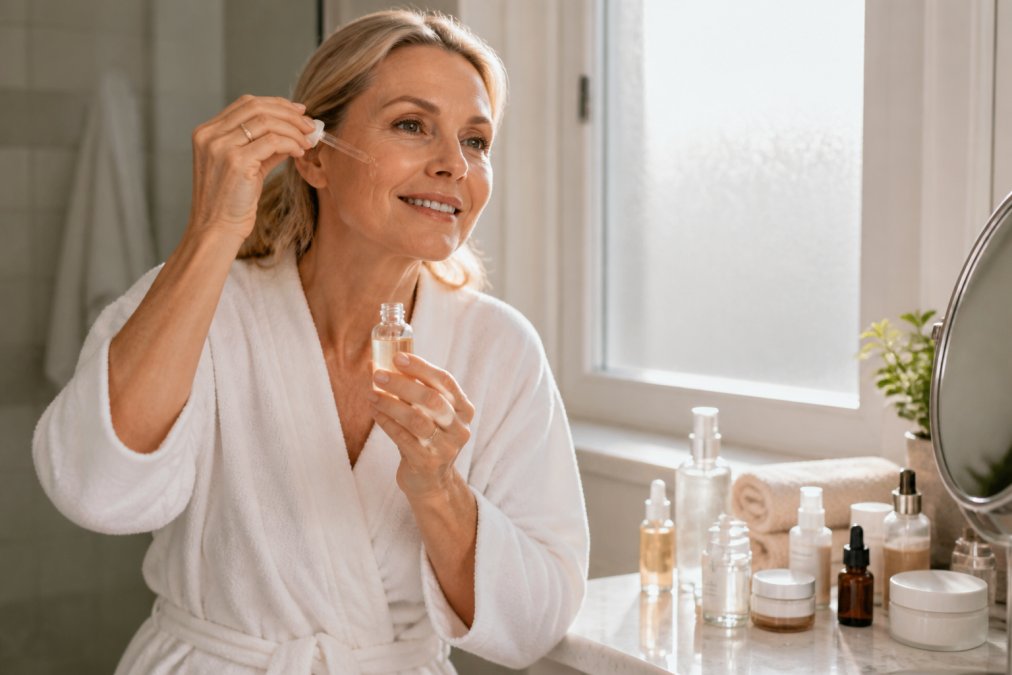
Morning Routine Steps
- Cleanse with a gentle, non-stripping cleanser, avoid anything that leaves skin feeling tight
- Apply vitamin C serum while skin is still slightly damp; allow 60 seconds to absorb
- Layer hyaluronic acid if your serum does not already contain it; apply to damp skin for maximum moisture retention
- Apply niacinamide (optional but highly effective for reducing pore appearance and uneven skin tone)
- Moisturize with a formula containing ceramides to reinforce the lipid barrier
- Apply SPF 30 or higher as the final step, this is not optional; sun damage is the single largest driver of dullness and pigmentation in skin over 50
Evening Routine Steps
- Double cleanse if you wore sunscreen or makeup, an oil-based cleanser first, then a gentle water-based one
- Exfoliate 2-3 nights per week using a low-concentration AHA or lactic acid product
- Apply retinol on non-exfoliation nights, start with a low concentration and increase gradually over several weeks
- Use a firming serum to support collagen production and skin elasticity overnight
- Seal with a rich moisturizer that contains ceramides, fatty acids, or peptides to support barrier repair while you sleep
The Ageless Glow Retinol Face Cream at $41.99 combines retinol's skin-renewal benefits with moisturizing agents, a practical choice for women who find straight retinol too drying on its own.

| Routine Step | Morning | Evening | Frequency |
|---|---|---|---|
| Gentle cleanse | Yes | Yes | Daily |
| Vitamin C serum | Yes | No | Daily |
| AHA/BHA exfoliant | No | Yes | 2-3x per week |
| Retinol | No | Yes | 3-4x per week |
| Moisturizer + ceramides | Yes | Yes | Daily |
| SPF 30+ | Yes | No | Daily |
How to Fix Dull Skin Over 50 With Nutrition
Most guides stop at "drink more water." That is genuinely the floor, not the ceiling.
Internal nutrition plays a significant role in how to fix dull skin over 50 because the skin is built from the inside out. Collagen production depends on adequate vitamin C intake from food, citrus, bell peppers, and leafy greens are all reliable sources. Without sufficient dietary vitamin C, topical serums have less raw material to work with.
Omega-3 fatty acids are equally important. These fats, found in fatty fish, walnuts, and flaxseed, are structural components of the lipid barrier. A diet chronically low in omega-3s contributes directly to a compromised skin barrier, moisture loss, and the kind of dull, rough texture that no serum fully compensates for.
Zinc is another underappreciated factor. This mineral supports skin renewal and helps regulate the inflammatory response that, when chronic, degrades collagen and elasticity. Pumpkin seeds, legumes, and shellfish are good dietary sources.
According to the National Institutes of Health Office of Dietary Supplements on zinc, zinc plays a critical role in skin integrity and wound healing, functions that become more relevant as cell turnover slows with age.
Beyond individual nutrients, blood sugar management matters more than most people realize. High-glycemic diets accelerate a process called glycation, where sugar molecules attach to collagen fibers and make them rigid and brittle. This shows up on the face as accelerated fine lines and loss of radiance. Reducing refined sugars and processed carbohydrates is one of the highest-use nutritional changes for skin quality over 50.
Lifestyle Factors That Steal Your Glow
Sleep is where skin repairs itself. During deep sleep, the body increases growth hormone secretion, which drives cell turnover and collagen synthesis. Chronic poor sleep does not just make you look tired, it measurably slows the skin renewal that brightening products depend on to work.
Chronic stress elevates cortisol, which suppresses estrogen and degrades collagen. For women already navigating post-menopausal hormonal shifts, high cortisol compounds the problem. Managing stress is not a wellness cliché in this context, it is a direct lever on skin quality.
Smoking and alcohol both accelerate skin aging through distinct mechanisms. Smoking reduces blood flow to the skin and depletes vitamin C. Alcohol disrupts sleep architecture and dehydrates the body, which shows up immediately in skin texture and glow.
Sun exposure without protection is the single most correctable lifestyle factor. According to the Skin Cancer Foundation's guidance on daily sunscreen use, daily use of broad-spectrum SPF 30 or higher is the most effective anti-aging measure available, more effective than any single skincare ingredient. For women over 50 already dealing with cumulative sun damage, consistent daily sunscreen use stops further pigmentation from forming while actives like vitamin C work on existing spots.
A common mistake is treating sunscreen as optional on cloudy days or when spending most of the day indoors. UVA rays, the ones responsible for pigmentation and collagen breakdown, penetrate glass and clouds. Daily application is non-negotiable if addressing dull skin over 50 is the goal.
Makeup Techniques That Brighten Dull Skin Over 50
Makeup cannot fix dull skin, but it can absolutely transform how it looks while your skincare routine does its work. The techniques that work for mature skin are fundamentally different from what most tutorials teach.

The biggest shift is moving away from full-coverage matte foundations. These products settle into fine lines, emphasize texture, and create a flat, heavy look that reads as older rather than polished. Skin over 50 reflects light better with lighter coverage.
Practical techniques that genuinely work:
- Use a luminous or satin-finish primer before foundation, this creates a smooth base and adds internal glow without glitter
- Apply foundation with a damp sponge rather than a brush; this sheers out the coverage and prevents it from sitting on top of skin
- Cream blush over powder, cream formulas blend into skin rather than sitting on top, creating a natural flush that powder blush cannot replicate on drier mature skin
- Highlight strategically: a small amount of liquid highlighter on the tops of cheekbones, the brow bone, and the inner corners of eyes creates the appearance of radiance without looking overdone
- Avoid heavy powder setting: a light dusting of translucent powder only in the T-zone prevents the powdery, flat finish that ages mature skin
- Peach or coral-toned concealer under the eyes neutralizes the bluish-gray tone that becomes more pronounced after 50, before applying your regular concealer
The goal is skin that looks like skin, just better. The most common makeup mistake over 50 is adding more product to compensate for dullness, which has the opposite effect.
Dull skin over 50 is a layered challenge that requires a layered response: targeted actives that address cell turnover and pigmentation, a routine that rebuilds the lipid barrier rather than stripping it, and lifestyle habits that support skin renewal from within. Ageless Glow offers a curated range of nutrient-rich formulas designed specifically for these concerns, from the Vitamin C Brightening Facial Serum to the Full-Size Korean Skincare Set for dark spots and glass skin. For a complete, targeted approach to dull skin over 50, explore the Ageless Glow collection and add the products that match your skin's specific needs.

Frequently Asked Questions
Does menopause cause dull skin?
Yes. After menopause, estrogen levels drop sharply, which slows collagen production, reduces skin elasticity, and decreases the skin's ability to retain moisture. Cell turnover also slows, meaning dead skin cells sit on the surface longer and scatter light unevenly. The result is a flat, dull complexion that lacks the radiance common in younger skin. Targeted ingredients like retinol, vitamin C serum, and hyaluronic acid directly address these post-menopausal changes.
How often should you exfoliate mature skin?
Most dermatologists recommend exfoliating mature skin one to two times per week. Over-exfoliating strips the lipid barrier, worsens moisture loss, and can trigger irritation and redness. Alpha hydroxy acids like glycolic or lactic acid are gentler options than physical scrubs for skin over 50. If your skin feels tight or looks redder after exfoliating, scale back to once per week and follow immediately with a hydrating moisturizer to support barrier repair.
Which vitamin deficiency causes a dull complexion?
Vitamin C deficiency directly impairs collagen production and antioxidant defense, dulling the complexion quickly. Low vitamin D is also linked to uneven skin tone and slower skin renewal. Zinc plays a role in skin repair and pigmentation regulation, so insufficient zinc can worsen dullness. Beyond topical products, eating foods rich in these nutrients, along with omega-3 fatty acids for the lipid barrier, supports brighter skin from the inside out.
How long does it take to see results from a new skincare routine over 50?
Most people notice improved hydration and a smoother texture within two to four weeks of consistent use. Brightening from a vitamin C serum typically shows within four to six weeks. Retinol takes longer: expect to see meaningful changes in fine lines, skin texture, and pigmentation after eight to twelve weeks. Results depend on consistency, sun protection, and whether the routine addresses the specific causes of dullness, such as barrier damage or hormonal skin changes.
This article was written using GrandRanker