

Table of Contents
- Why Mature Skin Needs a Different Exfoliation Approach
- Chemical vs Physical Exfoliation for Mature Skin
- The Best Exfoliating Acids for Aging Skin
- How to Exfoliate Sensitive Mature Skin Without Irritation
- Step-by-Step: Your Weekly Exfoliation Routine
- Exfoliation and Prescription Retinoids: What to Know
- Common Mistakes That Damage Mature Skin
- Frequently Asked Questions
Last Updated: October 3, 2026
Why Mature Skin Needs a Different Exfoliation Approach
Skin changes after menopause. Estrogen drops, collagen production slows, and skin thinning makes the outer layer more fragile.
So the goal shifts. You are no longer polishing away oil and buildup.
Here is what matters most: frequency, acid type, and aftercare. Get those three right and your skin looks brighter within weeks.
Chemical vs Physical Exfoliation for Mature Skin
Chemical exfoliation wins for aging skin because it dissolves dead skin cells evenly, without the friction that tugs on thinning skin. Physical scrubs rely on particles that can create microtears and irritation.
That said, physical exfoliation is not automatically off the table. It depends on your skin.
How to Tell Which Method Suits Your Skin
Ask three questions:
- Does your skin sting or flush easily? Choose chemical.
- Do you have visible broken capillaries? Choose chemical.
- Is your skin oily and resilient with no sensitivity? A soft physical scrub once a week is fine.
The Best Exfoliating Acids for Aging Skin
The best exfoliating acids for aging skin are AHAs like glycolic and lactic acid, plus PHAs for sensitive skin.
Lactic acid is the friendliest starting point for mature skin.
Glycolic acid is smaller and penetrates deeper. It is effective for dullness and texture, but it can sting on thin or reactive skin.
AHAs, BHAs, and PHAs: What Each One Does
| Acid Type | Best For | Strength | Frequency for Mature Skin |
|---|---|---|---|
| Lactic acid (AHA) | Dryness, dullness, fine lines | Gentle | 2-3 times weekly |
| Glycolic acid (AHA) | Texture, uneven tone | Moderate | 1-2 times weekly |
| Salicylic acid (BHA) | Clogged pores, oiliness | Moderate | 1-2 times weekly |
| PHAs | Sensitive, reactive skin | Very gentle | 3-4 times weekly |
Start with one acid. Add a second only after four weeks.
How to Exfoliate Sensitive Mature Skin Without Irritation
Sensitive mature skin needs a slower ramp-up than most guides admit. Begin with one application per week, not three, and treat the first four weeks as a calibration period rather than a results period.
Why Mature Skin Reacts Differently
After menopause, estrogen decline reduces sebum output and thins the stratum corneum, the outermost layer that holds water in and irritants out.
A common pattern is that transepidermal water loss rises for 24-72 hours after an acid application, which is why tightness and flaking often show up on day two, not the morning after.
Signs of Over-Exfoliation to Watch For
- Stinging that lasts more than a minute after application
- Flaking or rough patches that were not there before
- New redness around the nose and cheeks
- Skin that feels tight even after moisturizer
- Shiny, waxy-looking patches (a sign the barrier is compromised, not oily)
If you see any of these, stop all acids for seven to ten days. Then restart at half the frequency and half the contact time.
A Concrete Titration Protocol
Instead of guessing, use this ramp:
- Week 1: One application. Leave on for 5 minutes, then rinse. This tells you how your skin tolerates the acid without committing to a full overnight exposure.
- Week 2: One application, leave on. If no reaction within 48 hours, proceed.
- Week 3: Two applications, spaced at least 72 hours apart.
- Week 4: Two applications. Hold here for a month before considering a third.
If at any step you get stinging, redness, or flaking, drop back one step and stay there for two weeks. There is no prize for moving fast.
Adjusting for Menopausal Skin Changes
Hormonal shifts change the rules. If you are within a few years of menopause or in it now, expect:
- Lower starting tolerance. A concentration that worked pre-menopause may be too strong. Start one tier gentler (for example, 5% lactic instead of 10%).
- More dryness, not less. Exfoliation removes some of the little sebum you still produce. Pair every session with a ceramide-containing moisturizer the same night.
- Hot flash and flushing cycles. Skin is more reactive during a flush. If you are mid-flush, skip the acid that night.
- Slower recovery. Give yourself 72 hours between sessions minimum, not 48.
Barrier-Repair Ingredients to Keep on Hand
When irritation hits, reach for these rather than another active:
- Ceramides (look for ceramide NP, AP, or EOP on the label) to rebuild the lipid matrix
- Niacinamide at 2-5% to support barrier function and reduce redness
- Panthenol and allantoin for soothing
- Squalane or shea butter to seal moisture in overnight
Skip fragrance, essential oils, and alcohol-heavy toners during a recovery week. They add load your barrier cannot absorb.
When to See a Dermatologist
If irritation lasts more than two weeks after stopping acids, if you develop oozing, crusting, or spreading redness, or if a patch of skin stays raw despite gentle care, that is beyond at-home troubleshooting. A board-certified dermatologist can assess whether you are dealing with contact dermatitis, rosacea, or another condition that needs treatment rather than a routine tweak.
Step-by-Step: Your Weekly Exfoliation Routine
Here is a simple weekly system that works for most mature skin types.
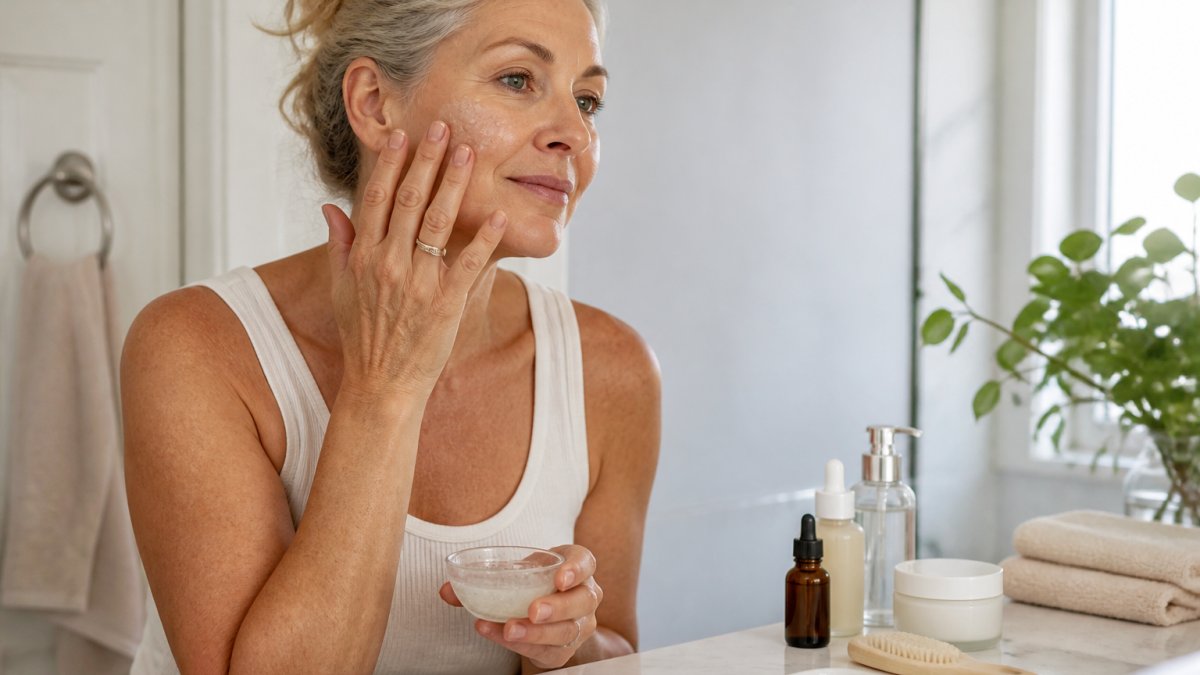
Night 1: Exfoliate
- Cleanse with a mild, non-foaming cleanser.
- Wait until skin is fully dry.
- Apply your acid of choice in a thin layer.
- Wait five minutes.
- Follow with a hydrating serum and a rich moisturizer.
Nights 2-3: Repair Focus on hydration. No acids.
Orange Facial Exfoliating Gel – Deep Moisturizing & Gentle Pore Cleansing Scrub →
Night 4: Exfoliate again Repeat the Night 1 steps if your skin tolerated the first round.
Nights 5-7: Repair and protect Hydrate, moisturize, and use sunscreen daily.
For the exfoliation step itself, a gentle option like our Orange Facial Exfoliating Gel lifts dead skin cells while delivering moisture, which suits mature skin that cannot afford to feel stripped.

What to Do After You Exfoliate
Hydration is not optional. It is the step that makes exfoliation safe.
Reach for a serum with hyaluronic acid and niacinamide, then seal it with a moisturizer. Our Hyaluronic Acid & Niacinamide Hydrating Serum plumps the skin and helps soften the look of fine lines after exfoliation.

Exfoliation and Prescription Retinoids: What to Know
If you use prescription retinoids, do not exfoliate on the same night. This is the single most common mistake in mature skin routines, and it is the one most likely to send you back to your dermatologist with a damaged barrier.
Why the Combination Is Risky
Prescription retinoids like tretinoin, tazarotene, and adapalene work by accelerating cell turnover and thinning the stratum corneum over time. That is the point. But it also means your barrier is already in a state of controlled remodeling. Adding an AHA or BHA on top does three things at once:
- Doubles the turnover signal. You are asking skin cells to shed faster than they can be replaced, which leads to raw, shiny, stinging skin.
- Strips barrier lipids the retinoid is already depleting. Retinoids reduce ceramide production temporarily. Acids remove what is left.
- Increases photosensitivity beyond what either active does alone. The combined effect is not additive, it is multiplicative.
Most dermatologists advise against same-night use for exactly these reasons. The goal is not to avoid both, it is to sequence them.
A Safe Alternating Schedule
For most mature skin on prescription retinoids, a workable week looks like this:
- Monday, Wednesday, Friday: Retinoid at night
- Sunday: Exfoliation (one acid, one layer, dry skin)
- Tuesday, Thursday, Saturday: Barrier repair only
If your skin is reactive or you are in your first six months on a retinoid, drop exfoliation to once every 10-14 days instead of weekly. You can always add frequency later. You cannot easily undo a barrier injury.
Which Acids Pair Best With Which Retinoids
Not all combinations are equal. A few practical pairings:
- Tretinoin (Retin-A, generic): The strongest of the common prescriptions. Pair with lactic acid or a PHA. Avoid glycolic on the same week if you are still adjusting to tretinoin.
- Tazarotene: Even more potent. Many suggest skipping exfoliation entirely for the first three months and using a gentle enzyme mask instead.
- Adapalene (Differin): Better tolerated. Lactic acid or low-strength salicylic acid (2%) is usually fine once weekly.
- Retinol (over-the-counter): Weaker than prescription, so a once-weekly AHA is generally well tolerated after the first month.
If you are unsure which category your product falls into, check the active ingredient on the label, not the marketing name.
What to Do If You Overdo It
Signs you have stacked too much: stinging that lasts, peeling in sheets rather than flakes, red patches that feel hot, or skin that burns when you apply a plain moisturizer.
If that happens:
- Stop both the retinoid and the acid for 7-10 days.
- Cleanse with water or a non-foaming cleanser only.
- Apply a ceramide-rich moisturizer twice daily.
- Use mineral sunscreen (zinc oxide or titanium dioxide) rather than chemical filters, which can sting compromised skin.
- Restart the retinoid alone for two weeks before reintroducing any acid.
A Note on Timing and Buffering
Some dermatologists recommend "buffering" retinoids, applying moisturizer before the retinoid, to reduce irritation. If you buffer, you can often tolerate a slightly higher retinoid frequency, but you still should not add an acid on the same night. The buffer reduces irritation, it does not eliminate the underlying turnover acceleration.
When to Ask Your Prescriber
If you are on a retinoid for acne, melasma, or another condition with a specific treatment timeline, check with your prescriber before adding any exfoliant. Some conditions worsen with added irritation, and your dermatologist may prefer to adjust the retinoid strength rather than layer in a second active.
Common Mistakes That Damage Mature Skin
The biggest mistake is treating mature skin like younger skin. It does not bounce back the same way.
Other frequent errors:
- Exfoliating daily because it "feels clean"
- Using a physical scrub with walnut shell or sugar particles
- Skipping sunscreen after exfoliation, when skin is most UV-sensitive
- Layering multiple acids in one routine
- Ignoring post-menopausal dryness and exfoliating anyway
Sun protection deserves its own note. Exfoliated skin is more vulnerable to UV damage, which worsens dark spots and breaks down collagen further. A broad-spectrum SPF 30 or higher every morning is not negotiable.
Fine lines, dullness, and loss of firmness do not have to define your skin at any age. From our Retinol Face Cream to our Firming Facial Serum, every product is made to help you see visible results.

Frequently Asked Questions
What is the best exfoliant for older skin?
For most mature skin, a gentle chemical exfoliant works better than a scrub. Lactic acid and glycolic acid are common choices because they loosen dead skin cells without the friction that can irritate thinning skin. If your skin is sensitive, start with a lower-strength leave-on treatment once a week. The goal is gentle exfoliation that supports cell turnover and collagen production, not aggressive polishing.
How often should you exfoliate skin over 50?
Most people over 50 do well with exfoliation once or twice a week. Mature skin has slower cell turnover and a thinner skin barrier, so daily exfoliation often leads to over-exfoliation, redness, and irritation. If you use prescription retinoids, cut back to once a week or pause exfoliating on the nights you apply them. Watch for signs like stinging or flaking and adjust frequency based on how your skin responds.
Should a 70-year-old woman exfoliate her face?
Yes, exfoliation can still help at 70, but the method matters more than ever. Post-menopausal skin tends to be drier and thinner, so physical scrubs and strong acids can cause irritation. A gentle exfoliating toner, a low-strength lactic acid product, or a hydrating exfoliating gel used once a week is usually enough. Always follow with a moisturizer to support moisture retention and skin elasticity.
What do dermatologists recommend for exfoliating mature skin?
Dermatologists generally recommend chemical exfoliants over harsh physical scrubs for aging skin, and they stress moderation. Look for AHAs like glycolic or lactic acid, or PHAs for sensitive skin, and use them at a frequency your skin tolerates. Pairing exfoliation with daily sun protection matters too, since exfoliated skin is more vulnerable to UV damage and free radicals that speed up fine lines.