

Table of Contents
- When to Start Using Anti-Aging Products
- How to Layer Anti-Aging Products Without Irritation
- What to Look for in the Best Anti Aging Serum
- Building a Dermatologist Recommended Anti-Aging Routine
- How to Choose Anti-Aging Products for Your Skin Type
- Budget vs. Luxury Anti-Aging Products: What Actually Matters
- Frequently Asked Questions
Last Updated: September 24, 2026
When to Start Using Anti-Aging Products
Most dermatologists suggest starting a preventive routine in your late 20s to early 30s. This is when collagen production begins its natural decline, though the change is gradual. Starting early helps you build skin tolerance before deeper lines and wrinkles appear.
Ageless Glow created this guide to help you plan that timeline without guesswork. The goal is simple: protect your skin barrier now so it holds up later.
Timing depends on your skin, not just your birthday. Consider these factors:
- Sun exposure history: Daily sun protection matters more than age.
- Skin type: Dry skin shows fine lines sooner than oily skin.
- Genetics: Family history can hint at how fast your skin changes.
- Lifestyle: Sleep, diet, and smoking all affect collagen.
Preventative care beats correction every time. A simple routine started at 30 usually outperforms a complex one started at 50.
How to Layer Anti-Aging Products Without Irritation
Layer from thinnest to thickest, and apply actives before moisturizer. This order lets each product absorb properly and reduces the chance of irritation.
The sequence looks like this:
- Cleanser to remove dirt and oil
- Toner to prep the skin
- Serum with your active ingredients
- Moisturizer to seal in hydration
- Sunscreen every morning, no exceptions
A common mistake is mixing retinoids and strong acids in the same step. That combination strips the skin barrier fast. Use retinoids at night and vitamin C in the morning instead.
Patch testing protects you here. Apply a small amount behind your ear for two days before using it on your face.
What to Look for in the Best Anti Aging Serum
The best anti aging serum pairs proven actives with barrier-supporting ingredients, and, increasingly in 2026, with microbiome-friendly and regenerative ingredients that competitors' generic guides still skip. Look for vitamin C, niacinamide, retinoids, peptides, and hyaluronic acid on the label, then check how each one actually works.
Vitamin C (L-ascorbic acid and derivatives). Supports collagen synthesis and interrupts the oxidative chain that breaks down collagen. L-ascorbic acid is the most studied form, but it is unstable in water and oxidizes when exposed to light and air, which is why airtight, opaque, or pump packaging matters. Less-stable derivatives (sodium ascorbyl phosphate, tetrahexyldecyl ascorbate) trade some potency for shelf stability and gentleness on sensitive skin.
Niacinamide. A form of vitamin B3 that supports the skin barrier, helps even tone, and reduces redness. It is one of the most forgiving actives and layers well with most routines, which makes it a strong first active for beginners.
Retinoids. Speed up cellular turnover to soften fine lines and improve texture. Over-the-counter retinol is weaker than prescription tretinoin but gentler; retinaldehyde sits between the two. Start two to three nights per week and build up. Retinoids also increase sun sensitivity, so daily SPF is non-negotiable.
Peptides. Short chains of amino acids that signal the skin to support firmness over time. Evidence is more modest than for retinoids, but they are well tolerated and pair well with other actives.
Hyaluronic acid and other humectants. Hold water in the skin for a plumper look. They work best layered under a moisturizer that seals in that water, a humectant alone in dry air can pull moisture from deeper layers.
The 2026 shift: barrier and microbiome ingredients. Competitors rarely cover this. Look for ceramides, cholesterol, and fatty acids (the three lipids your barrier is built from), plus prebiotic and postbiotic ingredients like oat, galactomyces ferment, and beta-glucan. A healthy barrier and a balanced skin microbiome reduce the irritation that derails active routines, which is why "barrier-first" serums are replacing aggressive acid-forward formulas.
Regenerative and growth-factor ingredients. Exosome-inspired and growth-factor serums are the headline trend for 2026. They aim to support the skin's own repair signaling rather than just exfoliate or hydrate. Evidence is still emerging, so treat bold claims with caution and prioritize formulas that also include proven barrier ingredients. Balancing these advanced signaling molecules with foundational ingredients for mature skin ensures that your routine remains both innovative and reliably restorative.
How to read the label. Ingredients are listed by concentration, highest first. If your active appears after the fragrance or preservative, it is likely present in a token amount. Check for:
- The active listed early, with a stated concentration where the brand provides one
- Airtight or opaque packaging for vitamin C and retinoids
- A moisturizer or SPF built into the formula if you want fewer steps
- Patch-test guidance from the brand
The American Academy of Dermatology's guidance on anti-aging skincare notes that sunscreen remains the single most effective step for slowing photoaging, no serum replaces it.
Ageless Glow's Anti-Wrinkle Vita C Capsule Cream combines vitamin C capsules with a collagen gel. The capsule format helps protect the vitamin C until use, and it layers well under sunscreen.

Building a Dermatologist Recommended Anti-Aging Routine
A dermatologist recommended anti-aging routine covers four basics: cleanse, treat, moisturize, and protect. That's it. Everything else is optional.
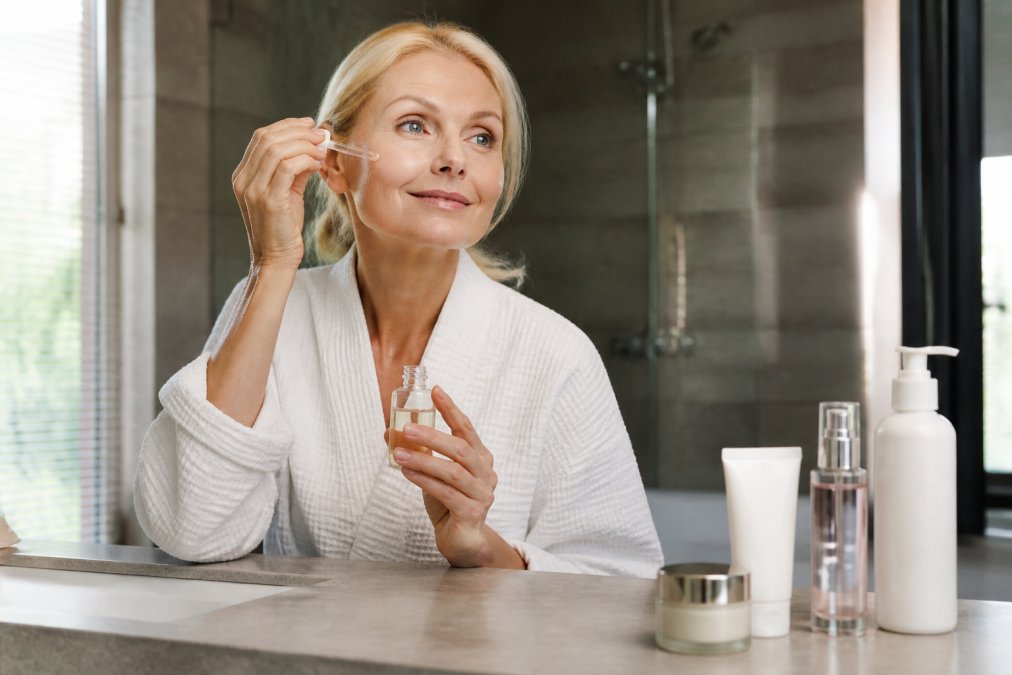
Here's a simple framework:
| Step | Morning | Evening |
|---|---|---|
| Cleanse | Gentle cleanser | Gentle cleanser |
| Treat | Vitamin C serum | Retinol |
| Hydrate | Moisturizer | Night cream |
| Protect | SPF 30+ | None needed |
Consistency matters more than the number of products. A short routine done daily beats a long one done twice a week.
For overnight renewal, Ageless Glow's Retinol Face Cream pairs retinol with hydrating botanicals. It suits sensitive skin that struggles with stronger formulas.

How to Choose Anti-Aging Products for Your Skin Type
Match products to your skin type first, then to your concerns. The wrong texture causes more problems than the wrong ingredient, a rich cream on oily skin can trigger breakouts, while a lightweight gel on dry skin leaves the barrier under-supported.
- Dry skin: Creams and oils with ceramides, cholesterol, and hyaluronic acid. Layer a humectant serum under a richer moisturizer to seal in water.
- Oily skin: Light gels and water-based serums. Niacinamide helps with oil control and texture; gel-cream moisturizers hydrate without heaviness.
- Combination skin: Layer a gel serum on the T-zone and a richer night cream on the cheeks. You do not need two full routines, just two textures.
- Sensitive skin: Fragrance-free formulas, fewer actives, and a slower ramp-up. Introduce one new product at a time and wait two weeks before adding another.
Sensitivity and tolerance ramp-up. A common pattern is to start a retinoid two nights per week, then add a night every two weeks as tolerated. If you get stinging, redness, or peeling, pause the active, focus on barrier repair (ceramides, gentle cleanser, moisturizer), and restart at a lower frequency.
Budget vs. Luxury Anti-Aging Products: What Actually Matters
Price rarely decides results. What matters is the active ingredient, its concentration, and how well the formula protects your skin barrier.
What to check before you buy:
- Is the active ingredient listed early on the label?
- Does the formula include a moisturizer or SPF?
- Is the packaging airtight to protect unstable actives like vitamin C?
- Does the brand offer patch-test guidance?
Frequently Asked Questions
What is the best anti-aging product that really works for fine lines?
The best anti-aging products for fine lines combine proven ingredients like retinoids, peptides, and vitamin C. Retinoids support collagen production and cellular turnover, while vitamin C brightens and defends against oxidative stress. A complete routine, such as the Gymsegbe Korean Skincare Set, pairs a daytime brightening serum with an evening retinol treatment to target fine lines around the clock. Consistency matters more than price, so choose a formula your skin tolerates and use it daily for at least eight weeks before judging results.
How long does it take to see results from anti-aging skincare?
Most people notice smoother texture and better hydration within two to four weeks, but visible changes in fine lines and wrinkles typically take eight to twelve weeks. Retinoids and vitamin C need time to influence collagen production and cellular turnover. Take photos every two weeks in consistent lighting to track subtle progress. If you stop after a month, you may miss the most noticeable improvements, so commit to a full three-month cycle before deciding whether a product works for you.
How do I know which anti-aging ingredients are right for my skin type?
Start by identifying your main concern. Dry skin benefits from humectants like hyaluronic acid and barrier-supporting moisturizers. Oily or acne-prone skin does well with lightweight serums and niacinamide. Sensitive skin should begin with lower-strength retinoids and always patch test. If you are unsure, a dermatologist recommended anti-aging routine often starts with a gentle cleanser, a antioxidant serum, and a broad-spectrum SPF 30 or higher. Introduce one active at a time to see how your skin responds.
Are there new anti-aging technologies to look for in 2026?
In 2026, regenerative skincare focuses on supporting the skin barrier and microbiome alongside traditional actives. Look for products that combine peptides, niacinamide, and postbiotics to strengthen dermal health. Sun protection remains the most effective anti-aging step, so choose a daily SPF 50 moisturizer. At-home devices that use LED light or microcurrent are also gaining popularity for firming, but they work best as a complement to a consistent topical routine, not a replacement.
Choosing anti-aging products gets easier once you stop chasing every new ingredient. The challenge is building a routine you'll actually follow for months, not days. Ageless Glow makes that simpler with nutrient-rich formulas and tools designed for visible results, from targeted serums to complete AM/PM sets. Get started with Ageless Glow and build a routine that fits your skin, your budget, and your life.