

Table of Contents
- Why Your Skin Changes and What an Anti-Aging Routine Can Fix
- The Best Anti-Aging Ingredients for Beginners (and What to Skip)
- Your Anti-Aging Skincare Routine Order: Morning Steps
- Your Anti-Aging Skincare Routine Order: Evening Steps
- When to Start Using Retinol Without Irritation
- How to Layer Products and Avoid Common Mistakes
- Lifestyle Factors, Budget Tiers, and Skin Sensitivity
- Your First 30 Days: What to Expect and When to Adjust
- Frequently Asked Questions
Last Updated: September 8, 2026
An effective anti aging routine for beginners doesn't require expensive serums or a 12-step ritual. The science is straightforward: collagen production slows, cell turnover decreases, and the skin barrier weakens. The fix is a consistent, layered routine built on proven ingredients. Simplicity and consistency beat complexity every time.
An anti-aging routine is a daily skincare practice using active ingredients like retinol, vitamin C, and SPF to support collagen, protect against photoaging, and maintain elasticity. Below, we'll cover which ingredients matter, the correct order to apply them morning and night, how to introduce retinol without wrecking your skin barrier, and what to expect in your first 30 days.
Why Your Skin Changes and What an Anti-Aging Routine Can Fix
Your skin ages for two reasons: intrinsic aging, which is genetic, and extrinsic aging, driven by sun exposure, pollution, and lifestyle. Photoaging from UV exposure is the dominant cause of visible wrinkles and age spots, which is why dermatologists rank daily sunscreen as the single most impactful anti-aging step (peer-reviewed research).
An anti-aging routine addresses these changes directly. Retinol speeds up cell turnover, vitamin C neutralizes free radicals, and moisturizers with ceramides and hyaluronic acid replenish lost hydration. The goal is not to stop time, but to support your skin's natural renewal so it looks healthier at any age.
The Best Anti-Aging Ingredients for Beginners (and What to Skip)
For a beginner, the essential active ingredients are retinol, vitamin C, and SPF. Retinol is the gold standard for stimulating collagen and reducing fine lines. Vitamin C brightens skin and fades dark spots. Daily SPF 30 or higher prevents further photoaging.

Supporting ingredients include hyaluronic acid for hydration, niacinamide for barrier support, and ceramides to lock in moisture. Look for a gentle cleanser that doesn't strip your skin, and consider an eye cream with caffeine or peptides for the under-eye area.
What to skip as a beginner: strong prescription retinoids, multiple active acids used together, and trendy ingredients without clinical backing. Starting with too many actives is the fastest way to irritate your skin barrier and derail your routine.
Your Anti-Aging Skincare Routine Order: Morning Steps
The correct order for your morning anti-aging skincare routine is: cleanse, vitamin C, moisturizer, then SPF. Vitamin C goes on clean skin to maximize absorption, and sunscreen is always the final step because it needs to form a protective film.
- Cleanse with lukewarm water and a gentle cleanser to remove overnight buildup.
- Apply vitamin C serum to dry skin. This antioxidant protects against daytime free radical damage and brightens your complexion.
- Moisturize with a hydrating day cream containing hyaluronic acid or ceramides.
- Finish with SPF 30 or higher. This is non-negotiable, even on cloudy days, because UV rays penetrate glass and clouds.
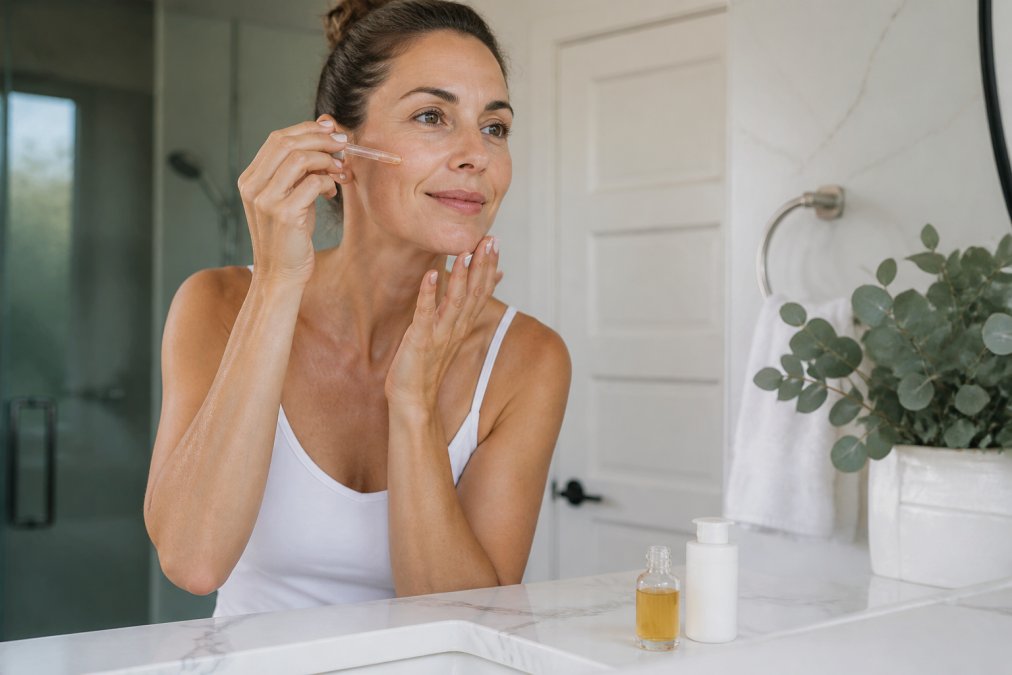
For a complete morning and night regimen, a full set can simplify the process. The Full-Size Korean Skincare Set for Dark Spots, Fine Lines & Glass Skin includes six products with a Hyper Serum for AM and PM use, covering brightening, hydration, barrier care, and daily SPF protection in one bundle.
Your Anti-Aging Skincare Routine Order: Evening Steps
Your evening routine is where repair happens. The order is: cleanser, retinol (a few nights per week), then a nourishing moisturizer or night cream. While you sleep, cell turnover accelerates, making this the optimal window for retinol to work.
- Double cleanse if you wear makeup or sunscreen. Start with an oil-based cleanser, then follow with a water-based one.
- Apply retinol to completely dry skin. Wait 20 minutes after cleansing to reduce irritation.
- Moisturize with a richer night cream containing peptides, ceramides, or niacinamide to support overnight renewal.
For mature or dry skin, the Retinol Face Cream combines retinol with hydrating botanicals to smooth wrinkles and even skin tone without excessive dryness. If you struggle with fine lines and dark circles around the eyes, the Instant Firm Eye Tightener Cream delivers a fast lifting effect in that delicate area.


When to Start Using Retinol Without Irritation
Retinol is the most evidence-backed anti-aging ingredient available without a prescription, but it is also the one most likely to cause beginners to quit. The problem is not the ingredient, it's the approach. Starting with too high a concentration, applying it too frequently, or using it on damp skin are the three most common mistakes.
Choosing Your First Retinol: Concentration and Form
Retinol is one of several vitamin A derivatives, collectively called retinoids. The potency ladder, from strongest to gentlest, is:
- Prescription retinoids (tretinoin, tazarotene), most potent, highest irritation risk
- Retinaldehyde, one step closer to retinoic acid than retinol, more potent but also more irritating
- Retinol, the standard over-the-counter form, well-studied and effective
- Retinyl esters (retinyl palmitate, retinyl acetate), gentlest, but significantly less potent
For a beginner, the sweet spot is a 0.1% to 0.3% retinol concentration. Products labeled simply "retinol" without a percentage are typically in this range. Avoid starting with 0.5% or 1.0%, the irritation from a high starting dose can damage your skin barrier and set back progress by weeks.
Form matters. Retinol comes in creams, serums, and oils. Creams are generally the gentlest because they contain more emollients that buffer the active. Serums are lighter but may be more irritating. For your first retinol, choose a cream or lotion in a tube or airless pump, jars expose the ingredient to light and air, accelerating degradation.
The 12-Week Tolerance-Building Protocol
Retinol requires a gradual introduction to allow your skin's receptors to upregulate and your barrier to adapt. Here is a week-by-week schedule that minimizes irritation while maximizing results:
| Week | Frequency | Application Method | What to Expect |
|---|---|---|---|
| Weeks 1-2 | 2 nights per week (e.g., Tuesday and Friday) | Apply to dry skin, wait 20 minutes after cleansing, moisturize over it | Mild tightness or slight dryness is normal; do not increase frequency |
| Weeks 3-4 | Every other night | Same as above | Possible "purge" breakouts or mild flaking; continue as directed |
| Weeks 5-8 | 4 nights per week | Same as above | Flaking subsides; skin texture begins to smooth |
| Weeks 9-12 | Nightly, if tolerated | Same as above | Visible improvement in fine lines and tone; if irritation returns, drop back to every other night |
The 20-minute rule. After cleansing, wait at least 20 minutes for your skin to be completely dry before applying retinol. Water on the skin's surface increases penetration, which can cause a "retinol burn", a red, stinging reaction that is entirely preventable.
The pea-sized amount. A pea-sized drop is sufficient for the entire face. Using more does not increase efficacy, it only increases irritation. Apply in thin dots across the forehead, cheeks, chin, and nose, then spread gently.
Understanding the Retinol Purge
The "purge" is real, occurring in up to 20% of users. When retinol accelerates cell turnover, it pushes congestion to the surface faster than your skin can shed it. The result is breakouts in your usual areas, usually starting in week 2 or 3 and resolving by week 6.
How to distinguish a purge from a negative reaction:
- Purge: Breakouts appear in your usual acne-prone zones, are small and superficial, and resolve within 4 to 6 weeks.
- Irritation: Redness, burning, stinging, or peeling occurs across the entire face, not just in breakout zones. This is a sign to reduce frequency or concentration.
If you experience irritation, do not stop cold turkey, this can cause a rebound effect. Instead, drop back to once per week for two weeks, then gradually increase again.
What to Do If Retinol Never Agrees With Your Skin
A small percentage of people cannot tolerate retinol at any over-the-counter concentration, often due to rosacea, eczema, or a reactive skin barrier. If you have followed the 12-week protocol and still experience persistent irritation, there are alternatives with clinical backing:
- Bakuchiol, a plant-derived compound that has been shown in clinical studies to provide comparable anti-aging benefits to retinol with significantly less irritation. Look for a 1% concentration.
- Peptides, signaling molecules like matrixyl and copper peptides stimulate collagen production without the cell-turnover acceleration that causes irritation.
- Azelaic acid, a gentle exfoliant that also reduces inflammation, making it suitable for rosacea-prone skin.
These alternatives are not as potent as retinol, but they are better than abandoning the anti-aging effort entirely.
How to Layer Products and Avoid Common Mistakes
The general rule for layering skincare is to apply products from thinnest to thickest consistency. This ensures each product absorbs properly. After cleansing, apply serums, then moisturizers, then oils or occlusives.
A common mistake is applying retinol and vitamin C in the same session. These are both potent actives, and layering them can overwhelm sensitive skin. Use vitamin C in the morning and retinol at night, giving each its own window to work.
Another frequent error is skipping moisturizer because skin feels oily. Even oily skin needs hydration, and a damaged barrier actually causes increased oil production as your skin tries to compensate.
Lifestyle Factors, Budget Tiers, and Skin Sensitivity
Most anti-aging guides stop at the bathroom sink, but the skin is a living organ that responds to everything you do. This section covers what happens inside your body, how to build a routine on a budget, and how to avoid irritation.
The Inside-Out Approach: Sleep, Diet, and Stress
Your skin's visible aging is roughly 20% intrinsic (genetic) and 80% extrinsic (environmental and lifestyle). While SPF is the dominant extrinsic factor, three internal levers directly influence collagen production and skin repair:
Sleep. During deep sleep, your body releases growth hormone, which stimulates collagen synthesis. A 2013 study in Clinical and Experimental Dermatology found that participants who slept 7 to 9 hours per night showed significantly better skin barrier recovery than those who slept 5 hours or less (PubMed). Chronic short sleep also elevates cortisol, which breaks down collagen and elastin.
Diet. Collagen production requires vitamin C as a cofactor, along with amino acids like proline and glycine. A diet rich in colorful vegetables, citrus fruits, and lean protein provides the raw materials. Conversely, a diet high in refined sugar drives glycation, where sugar molecules bind to collagen fibers, making them stiff and brittle, a primary contributor to loss of elasticity and deeper wrinkles.
Stress. Psychological stress triggers cortisol and adrenaline, which can increase oil production, worsen inflammatory conditions like acne and rosacea, and impair the skin's ability to repair itself. Simple stress-reduction practices, a 10-minute walk, deep breathing, or a consistent wind-down routine, have measurable effects on skin barrier function within weeks.
Building an Anti-Aging Routine on a Budget
The beauty industry would have you believe that effective anti-aging requires $200 serums. The evidence says otherwise. The three foundational actives, retinol, vitamin C, and SPF, are available at every price point. What changes with price is often texture, fragrance, packaging, and marketing, not the concentration of the active ingredient.
Here is a realistic budget breakdown for a beginner's first 90 days:
| Product Category | Drugstore Price Range | What to Look For | Where to Save |
|---|---|---|---|
| Gentle Cleanser | $8-$15 | Non-foaming, sulfate-free, pH 5.5 | Save here, it's on your face for 60 seconds |
| Vitamin C Serum | $15-$30 | 10%-15% L-ascorbic acid, opaque or airless pump | Spend here, vitamin C is unstable and needs good formulation |
| Retinol Cream | $15-$25 | 0.1%-0.3% retinol, in a tube not a jar | Spend here, retinol degrades in light and air |
| Moisturizer | $10-$20 | Ceramides, hyaluronic acid, fragrance-free | Save here, drugstore options are often identical to luxury |
| SPF 30+ | $10-$20 | Broad-spectrum, non-comedogenic | Spend here, you need to enjoy wearing it daily |
A complete, evidence-based routine can be assembled for under $80 total. Start with a cleanser, moisturizer, and SPF. After two weeks, add vitamin C. After another two weeks, introduce retinol. This staggered approach prevents waste and reduces irritation risk.
Skin Sensitivity and Patch Testing: The Safety-First Protocol
Beginners with sensitive skin, rosacea, or a history of allergic reactions need a more cautious approach. The most common reason people abandon retinol is not that it doesn't work, it's that they use it too often, too soon, or on a compromised barrier.
The 48-Hour Patch Test. Before applying any new active to your face, test it on a small area. The most reliable location is the inner forearm or behind the ear. Apply a pea-sized amount twice daily for 48 hours. If you experience redness, burning, or itching, wash the area and do not use the product on your face.
The Sandwich Method for Retinol. For reactive skin, apply a thin layer of moisturizer first, wait 10 minutes, then apply a pea-sized amount of retinol, and finish with another layer of moisturizer. This buffers the retinol's penetration, reducing irritation while still allowing it to work. Most practitioners find this allows sensitive-skin users to tolerate retinol at a concentration they otherwise could not.
Signs You're Over-Exfoliating. If your skin feels tight, looks shiny like plastic, or stings when you apply moisturizer, your barrier is compromised. Stop all actives, retinol, vitamin C, acids, and use only a gentle cleanser and a barrier-repair moisturizer with ceramides for 5 to 7 days.
Sustainability and Clean Beauty: A Beginner's Framework
The clean beauty movement has raised important questions about ingredient sourcing and environmental impact. However, "clean" is not a regulated term in the United States, the FDA does not define it, and brands use it inconsistently. A more useful framework for beginners is to focus on three verifiable criteria:
- Full ingredient disclosure. The brand lists every ingredient, not just "active" ones, on its website or packaging.
- Fragrance-free or naturally derived fragrance. Synthetic fragrance is a leading cause of contact dermatitis, especially for sensitive skin.
- Packaging that protects actives. Retinol and vitamin C degrade in light and air. Opaque, airless pumps or tubes are a sign the brand understands formulation science.
The trend toward "skinimalism", using fewer, better products, aligns with both sustainability and skin health. A 5-product routine with refillable packaging has a lower environmental footprint than a 12-product routine with single-use plastics. For beginners, resist the urge to buy a full regimen at once. Start with the essentials, observe how your skin responds, and add products only when you identify a specific need.
Your First 30 Days: What to Expect and When to Adjust
Your skin's cell turnover cycle takes about 28 days, so visible results require patience. Here is a realistic timeline for your first month:
| Phase | What to Expect | Action |
|---|---|---|
| Week 1 | Skin may feel tighter or slightly dry as retinol begins working | Apply retinol twice, moisturize generously |
| Week 2 | Possible "purge" breakouts or mild flaking | Continue as directed, do not increase frequency |
| Week 3 | Skin texture feels smoother, dullness begins to lift | Increase retinol to every other night if tolerated |
| Week 4 | Fine lines appear softened, skin looks more hydrated | Assess irritation; adjust frequency if needed |
During the first week, your skin is adjusting. You may notice dryness or tightness, which is normal. By week two, any purging should be manageable. By week three, most beginners report smoother texture and a visible reduction in dullness.
If you experience severe irritation, burning, or breakouts that worsen beyond week four, scale back your retinol frequency or concentration. The Vitamin C Brightening Facial Serum works well as a gentler daytime alternative while your skin acclimates to retinol at night. According to guidance from the American Academy of Dermatology, consistent daily sunscreen use and gradual retinoid introduction are the most evidence-backed strategies for preventing premature skin aging.
Building an effective anti aging routine for beginners is about consistency, not complexity. The challenge most people face is not a lack of products, but a lack of patience and a tendency to overcomplicate their regimen. Ageless Glow simplifies this with targeted, nutrient-rich formulas and complete skincare sets designed for visible results. Whether you need a full Korean skincare set, a gentle retinol cream, or a brightening vitamin C serum, our collection covers every step of your journey. Start with the basics, stay consistent, and give your skin the 30 days it needs to show you what it can do.
Frequently Asked Questions
At what age should you start an anti-aging routine?
Start in your mid-20s to early 30s with basics like sunscreen and a moisturizer. This is when collagen production and cell turnover begin to slow. If you are already in your 40s or 50s, starting now still delivers visible benefits. Consistency matters more than the age you begin. A simple routine with SPF, a gentle cleanser, and a moisturizer builds the foundation you can add active ingredients to later.
What is the difference between morning and evening anti-aging steps?
Morning focuses on protection: cleanse, vitamin C serum, moisturizer, and SPF 30 or higher. Evening focuses on repair: cleanse, then apply active ingredients like retinol or peptides, followed by a night cream. Sunscreen is non-negotiable in the morning because it prevents photoaging, while evening products work with your skin's natural repair cycle. Never apply retinol in the morning, as it increases sun sensitivity.
How long does it take to see results from an anti-aging routine?
Expect initial hydration and brightness improvements within 2 to 4 weeks. Fine lines and texture changes take longer: retinol typically shows measurable results at 8 to 12 weeks, while vitamin C can brighten dullness in about 4 to 6 weeks. Collagen-building effects from consistent use may take 3 to 6 months. If you see no change after 12 weeks, reassess your product strengths or add a targeted treatment.
How can I build a simple anti-aging routine without irritation?
Start with three products: a gentle cleanser, a moisturizer with ceramides, and SPF 30. Use each for one week before adding an active ingredient like retinol or vitamin C. Introduce new products one at a time, waiting 2 weeks between additions. Always patch test on your jawline for 3 days before applying to your face. If you have sensitive skin, apply active ingredients every other night and buffer them under moisturizer.
What is the 4-2-4 rule in skincare?
The 4-2-4 rule is a Korean skincare technique for cleansing. Massage an oil-based cleanser on dry skin for 4 minutes to dissolve sunscreen and sebum. Add water and emulsify for 2 minutes. Finish with a water-based cleanser for 4 minutes. This extended cleansing time helps prevent congestion and supports cell turnover without stripping the skin barrier. Beginners can start with shorter intervals and build up as their skin adjusts.
What are the essential ingredients for an effective anti-aging routine?
The essentials are vitamin C, retinol, hyaluronic acid, and SPF. Vitamin C is an antioxidant that brightens and protects against free radicals. Retinol boosts collagen and accelerates cell turnover to smooth fine lines. Hyaluronic acid hydrates and plumps to soften the look of wrinkles. SPF 30 or higher prevents photoaging, which causes most visible skin damage. Niacinamide and ceramides support the skin barrier and pair well with active ingredients.