

Table of Contents
- Why the Skin Around Your Nose Flakes: 6 Common Causes
- Is It Dryness, Eczema, or Seborrheic Dermatitis?
- Seborrheic Dermatitis Treatment for the Face
- How to Exfoliate Flaky Nose Skin Safely
- A Step-by-Step Nighttime Routine for Dry Flaky Skin
- How Long to See Skincare Results (and When to See a Dermatologist)
- Frequently Asked Questions
Last Updated: September 30, 2026
Why the Skin Around Your Nose Flakes: 6 Common Causes
Dry flaky skin around the nose usually comes down to one thing: a weakened skin barrier. This thin, delicate area loses moisture faster than the rest of your face, so it flakes first when something goes wrong. Dry flaky skin around the nose is a common complaint, and the fix depends entirely on the cause.
The six most common culprits:
- Cold weather and indoor heating that strip humidity from the air
- Harsh cleansers, scrubs, and over-exfoliation
- Medication side effects, including retinoids and some nasal sprays
- Seborrheic dermatitis, a yeast-related condition
- Perioral dermatitis, often triggered by heavy creams or steroid use
- Dehydration and low dietary fat intake
Cold Weather, Indoor Heat, and Low Humidity
Winter air holds less moisture, and indoor heating dries it further. Your skin responds by losing water through a process called transepidermal water loss. The nose, cheek folds, and mouth corners show it first because the barrier there is thinnest.
Harsh Products, Over-Exfoliation, and Medication Side Effects
What most guides miss is how often the trigger is something you're already using. A foaming cleanser, a weekly scrub, or a prescription retinoid can all strip the lipid barrier that holds moisture in.
Is It Dryness, Eczema, or Seborrheic Dermatitis?
The answer depends on where the flaking sits and how it looks. Plain dryness is dull and rough with no redness. Eczema brings itching and inflamed patches. Seborrheic dermatitis shows up as greasy, yellowish flakes in oily zones, especially the nose folds and brows.
Here's how to tell them apart:
| Sign | Dryness | Eczema | Seborrheic Dermatitis |
|---|---|---|---|
| Flake texture | Fine, dry | Dry, scaly | Greasy, yellowish |
| Redness | Mild | Strong | Moderate |
| Itch | Rare | Common | Sometimes |
| Main location | Cheeks, nose | Anywhere | Nose folds, brows |
| Best first step | Moisturize | See a doctor | Antifungal care |
Seborrheic Dermatitis Treatment for the Face
Seborrheic dermatitis on the face responds best to calming the yeast overgrowth behind it. A dermatologist-recommended approach combines an antifungal wash with a gentle, fragrance-free moisturizer.
What works, based on common clinical guidance:
- Wash with a mild cleanser and lukewarm water
- Use an antifungal product your doctor suggests, often containing ketoconazole or zinc pyrithione
- Apply a light moisturizer while skin is still damp
- Avoid heavy oils that feed the yeast
- Keep stress and cold weather in check, since both trigger flares
How to Exfoliate Flaky Nose Skin Safely
Safe exfoliation means removing dead flakes without tearing the barrier underneath. Most people scrub too hard and too often, which makes the flaking worse.
Follow this order:
- Stop all scrubs and brushes for one week
- Moisturize twice daily to soften flakes
- After a week, use a gentle chemical exfoliant once
- Wait three days before the next use
- Never exfoliate skin that stings or bleeds
A Step-by-Step Nighttime Routine for Dry Flaky Skin
A nighttime routine for dry flaky skin around the nose works by layering hydration, then sealing it in. Order matters more than the number of products. This sequence takes about five minutes and is built specifically for the thin, mobile skin beside the nostrils, where product tends to migrate and where barrier repair is slowest.
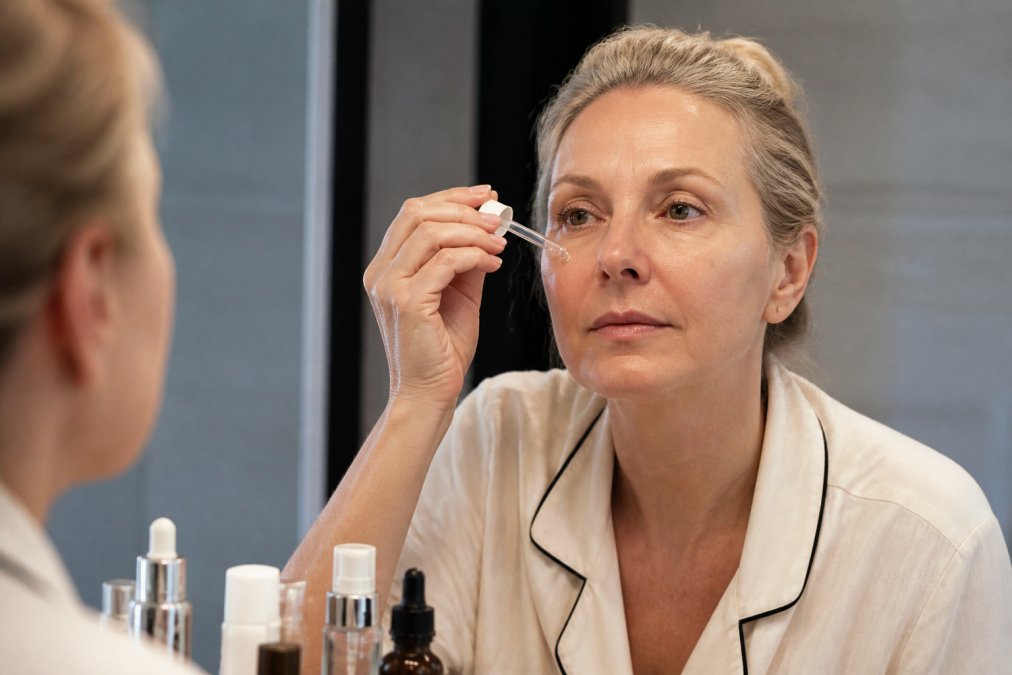
The five-minute nose-area protocol:
- Cleanse gently (60 seconds). Use a fragrance-free, non-comedogenic cleanser with lukewarm water, not hot. Hot water strips lipids from the stratum corneum, and the nose folds lose them fastest. Pat dry with a soft cloth; do not rub. Leave the skin slightly damp.
- Apply a humectant serum to damp skin (30 seconds). Hyaluronic acid, glycerin, and panthenol draw water into the upper layers. Apply within 60 seconds of patting dry, while the skin still holds surface moisture. On bone-dry skin, humectants can pull water from deeper layers instead, which is why timing matters.
- Add a soothing layer (30 seconds). A Centella Asiatica or colloidal oatmeal serum calms redness and supports the barrier. This step is optional on calm nights but valuable during a flare, when the nose area stings on contact.
- Seal with an emollient cream (60 seconds). This is the occlusion step. Look for ceramides, squalane, shea butter, or dimethicone. Press, don't rub, the cream into the nose folds and the creases beside the nostrils. Our All-Day & Night 2-Pack Cream for Face uses Centella Asiatica and niacinamide to soften and firm while you sleep.
- Spot-treat cracked or fissured areas (30 seconds). A thin layer of petrolatum or a ceramide ointment on cracked spots creates an occlusive seal that lets the barrier close overnight. Use a clean fingertip or a cotton swab to avoid introducing bacteria.
Two timing rules that change results:

- Wait 60 to 90 seconds between the serum and the cream. This lets the humectant absorb before the occlusive layer traps it. Applying both back-to-back dilutes the serum and reduces its effect.
- Apply the routine within three minutes of washing. This is the practical version of the 'soak and seal' approach dermatologists use for eczema: water in, then seal it before it evaporates.
Texture order, from thinnest to thickest:
Hyaluronic Acid & Niacinamide Hydrating →
| Step | Texture | Example ingredient |
|---|---|---|
| 1 | Liquid | Fragrance-free cleanser |
| 2 | Watery serum | Hyaluronic acid, glycerin |
| 3 | Light gel or serum | Centella Asiatica, panthenol |
| 4 | Cream | Ceramides, squalane, shea |
| 5 | Ointment (spot) | Petrolatum, ceramide ointment |
Makeup and Product Layering Over Flaky Patches
Makeup over flaky patches can look worse by noon if you layer it wrong. The fix is to prep the skin first, then build in thin layers, and to accept that the nose area needs a different technique than the rest of the face.
Morning prep before makeup:
- Cleanse, then apply a hydrating serum to damp skin
- Wait five minutes for the serum to absorb
- Apply a ceramide or squalane cream, then wait another two minutes
- Blot only the T-zone if it looks shiny, never blot the flaky nose area
Application rules for the nose area:
- Use a hydrating primer, not a mattifying or pore-blurring one. Mattifying primers contain silica and clays that pull moisture out of already-dry skin.
- Apply foundation with a damp sponge, pressing rather than sweeping. Sweeping lifts flakes and drags them across the face.
- Skip powder on the flaky area entirely. If you must set makeup, use a cream blush and a setting spray instead.
- Avoid long-wear and matte formulas, which rely on film-formers and drying alcohols. A hydrating or serum foundation sits better on compromised skin.
- Do not use a beauty sponge that has dried out, a damp sponge is what keeps the foundation from catching on flakes.
If you use retinoids or acne treatments:
How Long to See Skincare Results (and When to See a Dermatologist)
Realistic timelines by cause:
| Cause | First improvement | Full resolution |
|---|---|---|
| Cold weather / low humidity | 3 to 7 days with a humidifier and occlusive cream | 2 to 4 weeks |
| Harsh cleanser or over-exfoliation | 5 to 10 days after stopping the irritant | 3 to 6 weeks for full barrier repair |
| Retinoid or acne-treatment dryness | 2 to 4 weeks as skin adjusts, or sooner with a buffer routine | 6 to 12 weeks, sometimes longer |
| Seborrheic dermatitis | 1 to 2 weeks with antifungal care | Chronic, managed, not cured |
| Perioral dermatitis | Days to weeks after stopping the trigger | 4 to 12 weeks, often with prescription care |
Signs of progress to track weekly:
- Flakes soften and shrink rather than multiply
- Redness fades at the edges first, then the center
- Skin stops stinging when water or product touches it
- Makeup sits smoothly again without catching on texture
- The nose folds feel smooth to the touch, not rough or tight
When to see a dermatologist:
Book a visit if any of these apply:
- Flaking spreads beyond the nose to cheeks, brows, or hairline
- The area bleeds, crusts, oozes, or develops pus
- You have pain, swelling, or warmth in the area
- A home routine shows no change after four weeks of consistent use
- Red bumps appear around the mouth alongside the flaking, this pattern points to perioral dermatitis, which needs prescription care and often worsens with steroid creams
- You are on isotretinoin or a prescription retinoid and the flaking is severe or accompanied by cracking at the corners of the nose
- You have tried an over-the-counter antifungal for two weeks with no improvement
What a dermatologist will likely do:
For extra hydration during flare-ups, our Centella Cica Soothing Sheet Mask delivers Centella Asiatica to calm redness and support the barrier.

Frequently Asked Questions
What deficiency causes dry skin around the nose?
A lack of certain nutrients can show up as flaky skin, but dryness around the nose is more often caused by external factors like cold weather, low humidity, or harsh cleansers. If you eat a varied diet and still see persistent flaking, a doctor can check for underlying issues rather than guessing at supplements.
Is dry skin around the nose a sign of seborrheic dermatitis?
It can be. Seborrheic dermatitis often shows up as flaky, slightly greasy patches with redness in the creases beside the nose. Plain dryness tends to look dull and tight rather than red or inflamed. If you also notice itching or scaling in your eyebrows or hairline, seborrheic dermatitis becomes more likely and worth a dermatologist visit.
How can I treat seborrheic dermatitis on the side of my nose?
A seborrheic dermatitis treatment for the face usually starts with a gentle, fragrance-free cleanser and a moisturizer that supports the skin barrier. Your dermatologist may recommend an antifungal cream or a mild topical steroid for flare-ups. Avoid scrubbing the area, since friction makes redness and flaking worse.
Can dehydration cause peeling skin around the nose?
Dehydration plays a role, but it is usually one factor among several. When your body lacks water, your skin has less moisture to work with, and the thin skin around the nose shows it first. Drinking more water helps, and pairing it with a humectant serum and a barrier cream gives the area what it needs to recover.