

Table of Contents
- Why Shoppers Are Seeking a Dermstore Alternative for Nutrient-Rich Skincare
- Quick Comparison: Nutrient-Rich Skincare Picks and Prices
- The Benefits of Nutrient-Rich Skincare for Mature and Sensitive Skin
- How to Build a Professional Skincare Routine That Actually Fits Your Life
- Top Nutrient-Rich Formulas Worth Trying
- How to Spot Truly Nutrient-Rich Skincare: Ingredient Transparency and Bioavailability
- Budget-Conscious Luxury: Getting Professional-Grade Results for Less
- Conclusion
- Frequently Asked Questions
Last Updated: September 14, 2026
Why Shoppers Are Seeking a Dermstore Alternative for Nutrient-Rich Skincare
The hunt for a Dermstore alternative for nutrient rich skincare usually starts with a simple frustration. You've bought the serums. You've layered the creams. Your bathroom shelf looks like a dermatology clinic, yet your skin hasn't changed. At Ageless Glow, we understand the frustration: plenty of product, very little progress.
Nutrient-rich skincare is skincare formulated around active ingredients that support the skin's own repair systems, including antioxidants, fatty acids, and barrier lipids, rather than around fragrance and filler. The difference shows up in how your skin behaves over weeks, not hours.
Here's what most shopping guides get wrong: they rank products by brand prestige instead of by what's actually inside the bottle. Below, we break down what to look for, what to skip, and which formulas deliver real value.
Quick Comparison: Nutrient-Rich Skincare Picks and Prices
The table below compares formulas by ingredient focus, format, and price so you can match a product to your concern before you buy.
| Product | Key Actives | Format | Price | Best For |
|---|---|---|---|---|
| Full-Size Korean Skincare Set | Vitamin C, niacinamide, retinol, SPF50 | 6-piece AM/PM set | $170.94 | Complete routine in one purchase |
| Centella 5% Niacinamide Gel Cream | Niacinamide, vitamin C, squalane | Gel cream | $38.99 | Redness and oily-dehydrated skin |
| Dynasty Cream Double Set | Plant actives, occlusive film | Cream, 2 x 100ml | $39.00 | Dry skin needing lasting moisture |
| Hyaluronic & Niacinamide Serum | Hyaluronic acid, niacinamide | Serum | $95.99 | Fine lines and enlarged pores |
| Hyaluronic Aqua Boost Ampoule | Low-molecular hyaluronic acid | Ampoule | $125.99 | Deep dehydration |
| Rice Raw Pulp Face Serum | Rice powder, plant collagen, glycerin | Serum | $41.99 | Oil control and dullness |
| Retinol Face Cream | Retinol, botanical extracts | Cream | $41.99 | Fine lines and uneven tone |
| Vitamin C Brightening Facial Serum | Vitamin C, vitamin E, hyaluronic acid | Serum | $79.99 | Dark spots and sun damage |
| Vitamin C Tone Repair Serum | Vitamin C derivatives, niacinamide, glutathione | Serum | $95.99 | Uneven, dull tone |
| Centella Cica Sheet Mask | Centella Asiatica | Sheet mask | $46.99 | Reactive, irritated skin |
The Benefits of Nutrient-Rich Skincare for Mature and Sensitive Skin
The clearest benefit of nutrient-rich skincare is barrier support. As skin matures, natural lipid production slows, so moisture escapes faster and irritants penetrate more easily (pubmed.ncbi.nlm.nih.gov). Formulas built on ceramides, fatty acids, squalane, and niacinamide replace some of what's been lost.
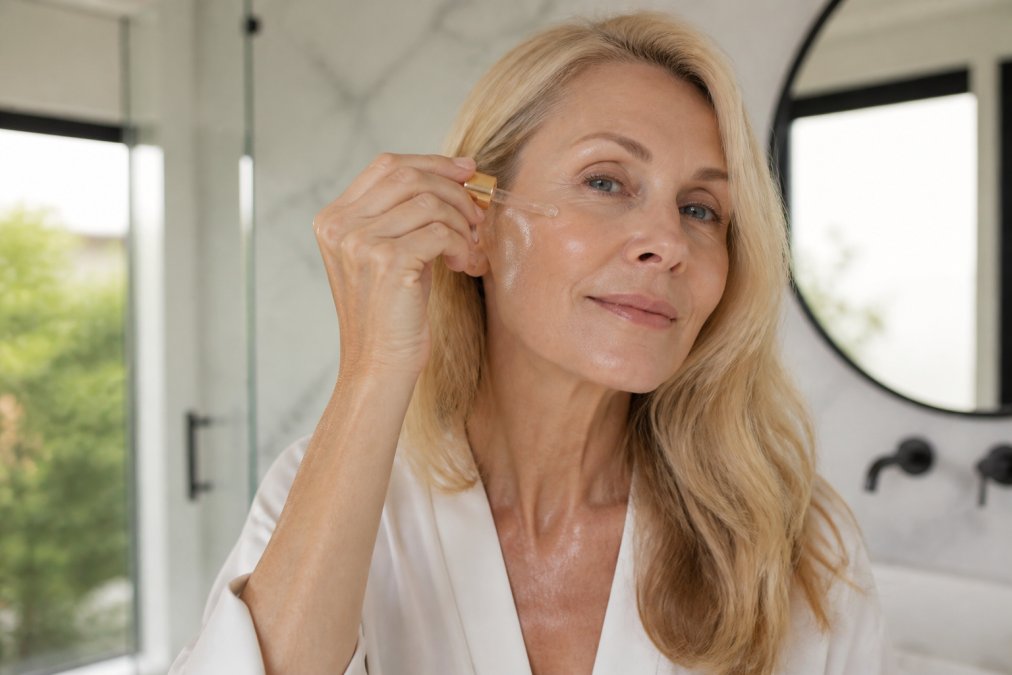
Sensitive skin responds to the same logic. Fewer filler ingredients mean fewer chances for a reaction, which is why hypoallergenic and non-comedogenic formulas tend to suit reactive skin better than heavily fragranced ones.
What most guides miss is that concentration matters less than delivery. A modest amount of a well-formulated active usually outperforms a high percentage that never absorbs. That's why it's important to look at bioavailability first, and marketing claims second.
How to Build a Professional Skincare Routine That Actually Fits Your Life
A nutrient-rich routine is not a longer routine. It is a sequence engineered so each nutrient reaches the layer of skin where it can actually do its job.
The barrier-first principle
The skin barrier is a lipid matrix of ceramides, cholesterol, and free fatty acids arranged in a "brick and mortar" structure. When that matrix is compromised, water escapes and irritants enter. Actives applied to a compromised barrier can sting, stall, or trigger rebound irritation. That is why a nutrient-rich routine often starts by feeding the barrier, not by attacking a concern.
- Step 1, Cleanse gently. A non-comedogenic, low-surfactant cleanser removes residue without stripping the lipids you are about to replenish. Cleansers rinse off in under a minute, so this is the step to save money on.
- Step 2, Pre-load hydration on damp skin. Apply a humectant (glycerin, low-molecular-weight hyaluronic acid) while skin is still damp. Humectants pull water into the upper layers; applied to dry skin in a dry room, they can pull moisture the other direction.
- Step 3, Treat with one active. Antioxidants (vitamin C, vitamin E, niacinamide) in the morning; retinoids and exfoliating acids at night. One new active at a time, two to three nights per week, until skin stops reacting.
- Step 4, Seal with lipids. Ceramides, squalane, shea, and fatty-acid-rich oils slow water loss and hold the actives against the skin longer. This is the step that makes the previous three worth doing.
- Step 5, Protect. Broad-spectrum SPF every morning. Without it, the antioxidant and retinoid work is largely undone by UV exposure.
Why the order is not arbitrary
Retinoids degrade in light and increase photosensitivity, so they belong at night. Vitamin C is a reducing agent that works best in the morning, where it can neutralize UV-generated free radicals before they damage lipids and collagen. Niacinamide is stable and pairs with almost everything, which is why it shows up in both AM and PM formulas. Layering vitamin C and retinol in the same step raises irritation risk without improving results, separate them by time of day, not by product count.
A weekly rhythm that respects the barrier
- Most nights: cleanse, hydrate, treat (alternating retinoid and non-retinoid nights), seal.
- One night per week: exfoliate or mask, never both.
- Every morning: antioxidant, moisturizer, SPF.
Matching the routine to your concern
- Dehydration and dullness: humectant serum plus a ceramide or squalane cream.
- Fine lines and uneven tone: morning vitamin C, evening retinoid, daily SPF.
- Redness and reactivity: centella, panthenol, and niacinamide, with fragrance-free formulas and no exfoliating acids until skin settles.
- Oiliness with dehydration: lightweight gel cream with niacinamide and low-molecular hyaluronic acid rather than heavy occlusives.
The routine that works is the one you can repeat for twelve weeks. Four reliable steps beat ten occasional ones, and a barrier that stays intact is what lets the nutrients in those steps actually absorb.
Top Nutrient-Rich Formulas Worth Trying
The formulas below are grouped by function so you can build a routine around your actual concern rather than around a product name.
Serums for Brightening and Barrier Support
The Vitamin C Brightening Facial Serum pairs vitamin C with vitamin E and hyaluronic acid, a combination aimed at dark spots and fine lines. The Hyaluronic Acid & Niacinamide Hydrating Serum targets dehydration and pore appearance, while the Rice Raw Pulp Face Serum leans on rice powder and plant collagen for oil balance.
Moisturizers and Creams for Lasting Hydration
The Centella 5% Niacinamide Radiance Gel Cream suits combination and reactive skin thanks to its lightweight texture. For drier skin, the Dynasty Cream Double Set forms a thin occlusive film that holds actives against the skin. The Retinol Face Cream splits the difference, combining retinol with hydrating botanicals.
![[haruharu wonder] Centella 5% Niacinamide Radiance Gel Cream 90g](https://cdn.shopify.com/s/files/1/1012/8208/7234/files/product_images_1784811278.product-image-1_5567b59a-1742-44fb-af1e-21a6e4158f841786073605.jpg?v=1786073625)
![[Beauty of Joseon] Dynasty Cream 100ml x 2ea [Double SET]](https://cdn.shopify.com/s/files/1/1012/8208/7234/files/product_images_1741698948.64318950363489859_10463205621786072503.jpg?v=1786072525)
Complete Sets for a Full AM/PM Routine
If you'd rather not assemble a routine piece by piece, the Full-Size Korean Skincare Set covers toner, essence, AM serum, SPF50 moisturizer, PM retinol serum, and night cream in one purchase. It's the fastest route to a complete system, and the AM/PM split means you're not guessing which product goes where.

How to Spot Truly Nutrient-Rich Skincare: Ingredient Transparency and Bioavailability
Two filters separate a genuinely nutrient-rich formula from a marketing claim: what is in the bottle, and whether your skin can absorb it. Most shopping guides stop at the ingredient list. The supply chain and the delivery system are where the real differences hide.
Filter 1, Ingredient transparency, read three ways
Concentration and form. "Vitamin C" tells you nothing. L-ascorbic acid is the most studied form but is unstable in water and oxidizes quickly; derivatives such as sodium ascorbyl phosphate or tetrahexyldecyl ascorbate are more stable but convert in skin at varying rates. A label that names the form and the percentage is a label you can evaluate. A label that names neither is a claim, not a specification.
Sourcing and purity. Nutrient quality starts upstream. Where a botanical extract is grown, when it is harvested, and how it is extracted all affect the concentration of the compounds you are paying for. Cold-pressed and low-heat extraction preserve heat-sensitive antioxidants; solvent-heavy extraction can leave residues and degrade actives. Brands that publish sourcing or supplier standards are giving you something to verify. Brands that do not are asking you to trust the front of the bottle.
Third-party testing. Independent testing for heavy metals, microbial contamination, and stated potency is the difference between a claim and a verified claim. If a brand will not disclose testing, treat "nutrient-rich" as unverified.
Filter 2, Bioavailability and delivery systems
Bioavailability is how much of an active actually reaches the layer of skin where it can work. A high percentage that sits on the surface is worth less than a modest percentage that penetrates. Three delivery approaches matter most:
- Molecular weight. Low-molecular-weight hyaluronic acid penetrates further into the upper layers than high-molecular versions, which sit closer to the surface and mainly hold water there. Formulas often combine both for surface and deeper hydration.
- Liposomes and encapsulation. Liposomes are lipid vesicles that carry an active through the outer layer and release it where the barrier is thinner. Encapsulation protects unstable actives, retinol is the classic case, from light and oxygen until they reach the skin, reducing irritation and preserving potency.
- Penetration enhancers and vehicle design. Fatty alcohols, certain esters, and well-designed emulsions can improve how actives partition into the skin. The vehicle is not filler; it is part of the delivery system.
What this means when you shop
- Prefer labels that name the active form and percentage over labels that list an ingredient with no detail.
- Look for delivery language, liposomal, encapsulated, time-release, low-molecular-weight, and treat it as a claim to verify against the rest of the label.
- Check whether the brand publishes sourcing or testing standards. Transparency is a behavior, not a badge.
- Remember that niacinamide absorbs readily at moderate concentrations, so a 5% formula can outperform a 10% one that irritates.
For broader context on cosmetic labeling and ingredient disclosure, the FDA's cosmetic labeling guidance explains what manufacturers are required to list. The American Academy of Dermatology also publishes ingredient explainers worth checking before you commit to a new active.
Budget-Conscious Luxury: Getting Professional-Grade Results for Less
Professional-grade results don't require a luxury price tag. The formulas above range from $38.99 to $170.94, and the most expensive option is a six-product system, not a single jar. Compare that to buying the same steps individually and the set math works in your favor.
A practical approach: spend on the treatment step, save on the cleanser. Cleansers rinse off within a minute, so a gentle, non-comedogenic formula does the job without a premium price. Put your budget into serums and moisturizers, where ingredients stay on your skin.
Conclusion
The real challenge with switching retailers isn't finding products, it's finding formulas you can actually verify. Ageless Glow curates targeted skincare built on nutrient-rich ingredients, from brightening serums to complete AM/PM sets, with transparent ingredient lists you can read before you buy. Our collection spans anti-aging, hydration, and barrier support, plus facial tools designed for low-effort daily use. Get started with Ageless Glow and build a routine that fits your skin and your schedule.
Frequently Asked Questions
What are the best online retailers for professional-grade skincare?
The best retailers stock clinical-strength formulas with clear ingredient lists and third-party testing. Look for stores that publish full ingredient breakdowns, offer dermatologist-tested products, and carry nutrient-rich options like vitamin C serums, niacinamide creams, and retinol treatments. Ageless Glow, for example, curates Korean skincare sets and targeted serums with transparent sourcing, so you can verify what you are buying before it arrives.
How do I identify truly nutrient-rich skincare products?
Check the ingredient list for proven actives such as vitamin C, niacinamide, hyaluronic acid, ferulic acid, and resveratrol near the top of the label. Nutrient-rich skincare also includes fatty acids and lipids that support the skin barrier. Avoid products where beneficial ingredients appear after preservatives or fragrance. Look for dermatologist-tested claims and clinical trial references, since these signal the formula has been evaluated for how well it works, not just marketed well.
Is it worth buying skincare from specialized boutiques versus large retailers?
Specialized boutiques often carry smaller, curated brands. Large retailers may offer convenience and loyalty points, but their shelves are dominated by mass-market formulas. If your goal is nutrient-rich skincare with clinical efficacy, a boutique that explains sourcing and formulation stability can give you more confidence in what you are applying.
What should I look for in a skincare retailer's ingredient transparency?
A transparent retailer lists full INCI names, explains what each active ingredient does, and states concentrations where relevant. They should also disclose whether products are hypoallergenic, non-comedogenic, and free from synthetic additives if they claim so. Look for certifications like vegan or cruelty-free seals and third-party dermatological testing. If a retailer cannot tell you what is in the bottle or where ingredients were sourced, that is a red flag for nutrient-rich skincare.
Are there smaller, curated skincare brands that offer better nutrient profiles?
Yes. Smaller brands often focus on fewer products. For example, a niacinamide and centella gel cream or a rice pulp serum can deliver nutrients. These brands also tend to publish sourcing details. The trade-off is limited shade ranges or fewer product categories, but for targeted concerns like fine lines, dullness, or sensitivity, a curated lineup can be very effective.