

Table of Contents
- How Red Light Therapy Helps Acne Scars
- What the 630-660 nm Wavelength Does for Collagen
- Red Light Therapy Frequency for Acne Scars: Daily or Every Other Day?
- How Long to Use Red Light Therapy for Acne Scars Per Session
- Red Light Therapy Side Effects on Face and Who Should Avoid It
- What to Pair With Your Sessions for Fading Scars
- Common Mistakes That Slow Down Results
- Frequently Asked Questions
Last Updated: September 26, 2026
How Red Light Therapy Helps Acne Scars
Yes, you can use red light therapy daily for acne scars, and for many people that steady routine makes the difference. It is a non-invasive treatment that uses specific wavelengths of light to calm inflammation and support collagen production over time.
Acne scars form when deep breakouts damage the skin and it heals unevenly, some as shallow dips, others as dark marks called post-inflammatory hyperpigmentation. Red light therapy targets both by encouraging skin to rebuild.
What the 630-660 nm Wavelength Does for Collagen
The 630-660 nm wavelength is the sweet spot for red light therapy. This narrow band reaches the dermis, just below your skin's surface, where it supports collagen synthesis and helps skin look firmer and smoother.
Here is the simple version of how it works:
- Light energy enters your skin cells
- It supports mitochondrial function, the part of the cell that makes energy
- Cells produce more adenosine triphosphate, their main fuel
- This fuel supports fibroblast stimulation and new collagen
- Over time, dermal repair and scar remodeling follow
This process is called photobiomodulation.
The therapeutic window matters: too little light does nothing, too much irritates skin, so frequency and session length both matter.
Red Light Therapy Frequency for Acne Scars: Daily or Every Other Day?
Daily use is safe for most red light devices and often gives the best results for acne scars. Match your routine to your goal, device, and skin's response: short daily sessions during treatment, dropping to a few a week once scars fade.
Treatment consistency beats intensity: a short daily session usually outperforms one long weekly session. The biphasic dose response, low doses stimulate repair while high doses suppress it, is why more is not better.
Treatment Phase vs. Maintenance Phase
Think of your routine in two phases.
Treatment phase: While scars are visible, aim for daily sessions, commonly 5 to 7 per week for 8 to 12 weeks before reassessing.
Maintenance phase: Once scars fade, two to three sessions a week holds results; some drop to once a week and still maintain tone and texture.
Move to maintenance when you are happy with your skin, and back to daily if new breakouts leave fresh marks.
Device-Specific Usage Protocols
A mask, wand, and panel deliver very different intensities, so the same 20-minute session can under-dose one device and over-dose another.
LED face masks (flexible or rigid): These sit against the skin, so surface intensity is lower than a panel. Typical protocols run 10 to 20 minutes once daily; coverage is even but power is modest, so daily use is well tolerated.
Handheld wands: These concentrate diodes in a small head, so you treat one zone at a time, typically 3 to 5 minutes per area, roughly 10 to 15 minutes total. Daily use is fine, but keep the wand moving; holding it still is where irritation starts.
Full-body or face panels: Panels put out the highest irradiance, so sessions are shorter, often 5 to 10 minutes at 6 to 12 inches. If warmth or redness lasts over an hour, cut the time or drop to every other day.
Travel Size Skincare Kit for Dark Spot →
Combination devices (red + blue + infrared): Many acne devices mix wavelengths, red (630-660 nm) for repair, blue (around 415 nm) for acne bacteria, near-infrared (around 830 nm) for deeper tissue.
How to Set Your Own Frequency
If your device's manual is vague, start here and adjust:
- Week 1: Every other day, low end of the time range. This is a tolerance test.
- Week 2-3: If no irritation, move to daily at the low end of the range.
- Week 4 onward: Build session length toward the middle of the range if results feel slow and skin feels calm.
- Any sign of redness lasting over an hour, dryness, or stinging: drop back one step for a week.
How Long to Use Red Light Therapy for Acne Scars Per Session
Most sessions should last 10 to 20 minutes, enough cumulative exposure without overdoing it. Past a point, extra minutes add irritation risk, not results.
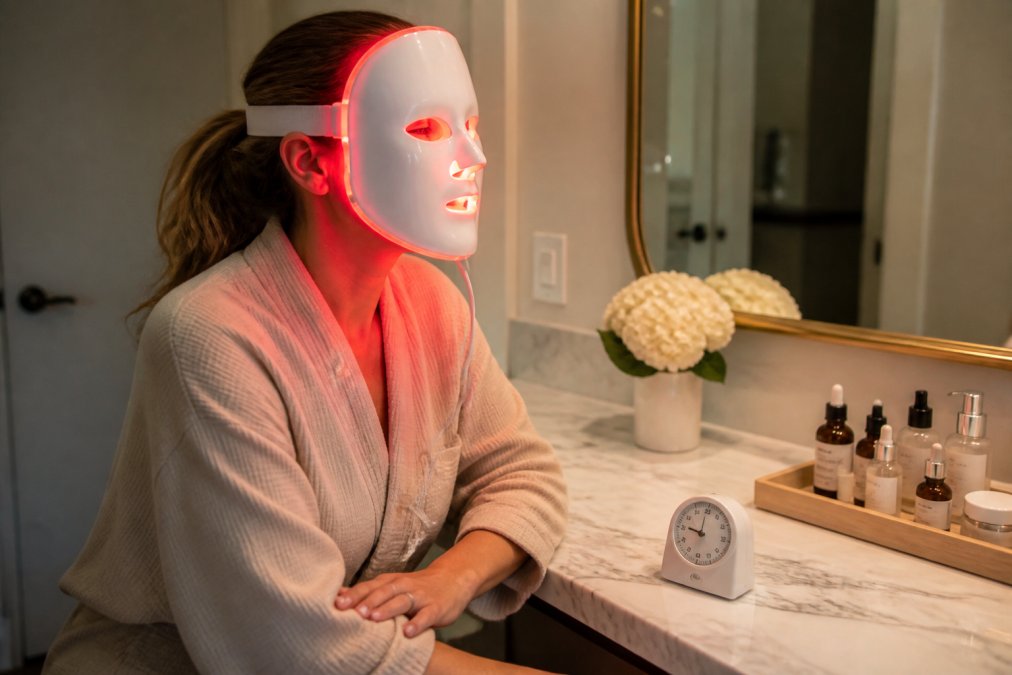
A few practical rules:
- Start with 10 minutes per session
- Build to 15 or 20 minutes as your skin adjusts
- Keep the device a few inches from your skin
- Clean your face first so light reaches bare skin
- Follow your device's own guide when in doubt
Device-Specific Usage Protocols
A panel puts out more power and needs less time; a mask sits close to the skin and often needs longer sessions. Check three things before you start.
- Wavelength: Look for 630-660 nm for scars
- Distance: Closer is stronger, so adjust time to match
- Power: Higher output means shorter sessions
Red Light Therapy Side Effects on Face and Who Should Avoid It
Red light therapy side effects on the face are rare and usually mild. Some notice short-term erythema, a slight redness fading within an hour; others feel warmth or mild dryness. These settle as skin adjusts. Because the treatment uses no UV and little heat at typical home-device intensities, burns and peeling are uncommon when directions are followed.
- Blistering or burns
- Lasting redness or swelling
- New pain or irritation that gets worse
- Changes in a mole or new dark spot that does not fade
Who Should Not Use It (or Should Ask First)
Red light is gentle, but it is not appropriate for everyone at every moment.
Skin Sensitivity and Barrier Status
A skin barrier that is already stressed needs care. If your skin stings from products, flakes, or reacts to water, pause before adding light sessions. Signs of a compromised barrier include:
- Stinging or burning when applying moisturizer
- Persistent redness or tightness
- Flaking or rough patches that do not improve
- New sensitivity to products you used before without issue
How to Reduce Your Risk
A few habits cut most of the risk:
- Start short. Begin at the low end of your device's time range.
- Protect your eyes. Use the goggles that came with your device, especially with panels.
- Skip actives on session nights. Do not stack red light with retinoids, strong acids, or exfoliants on the same evening.
- Keep the device clean. Wipe the surface between uses, especially if you share it.
- Watch the first week closely. Most irritation shows up early, not after months of use.
What to Pair With Your Sessions for Fading Scars
Red light works best as part of a routine. Pair it with products that support brightening and repair, a simple, targeted plan beats a shelf of random buys.
Look for these helpers:
- Vitamin C to support a more even tone
- Niacinamide to help with tone and texture
- Hyaluronic acid to keep skin hydrated
- Daily SPF to protect fading marks from new darkening
Common Mistakes That Slow Down Results
The biggest mistake is quitting too soon. Red light therapy is a slow build, and clinical evidence shows results come from steady use over weeks, not days. Other common trips:

| Mistake | What It Costs You | The Fix |
|---|---|---|
| Skipping days | Slower collagen support | Keep sessions daily in treatment phase |
| Sessions too long | Redness and irritation | Cap at 10-20 minutes |
| Treating through makeup | Less light reaches skin | Cleanse first |
| No sun protection | New dark marks form | Wear SPF every day |
| Switching devices often | No steady routine | Stick with one device for weeks |
Frequently Asked Questions
Is it safe to use red light therapy on your face every day?
Daily use is generally safe for most people when sessions stay within the device maker's recommended time, usually 10 to 20 minutes. The main risk of overuse is temporary erythema, or mild redness, rather than lasting damage. If your skin feels hot, tight, or irritated after a session, drop back to every other day until it settles. People with photosensitivity, active cold sores, or a history of skin cancer should check with a dermatologist before starting daily sessions.
How long does it take for red light therapy to fade acne scars?
Most users notice early changes in skin texture and redness within 4 to 8 weeks of consistent use. Visible fading of post-inflammatory hyperpigmentation and flatter scar tissue typically takes 3 to 6 months, since collagen remodeling is a slow process. Deep pitted scars respond less predictably than flat marks. Taking progress photos every two weeks helps you track subtle changes that are easy to miss in a mirror.
What is the best red light therapy frequency for acne scars?
For active treatment, most at-home devices are used once daily, five to seven days a week, for the first 8 to 12 weeks. After that, many people shift to three or four sessions a week to maintain results. Consistency matters more than intensity, so a shorter session done daily beats an occasional long one. Follow your specific device's manual, since LED panel power and distance change the recommended schedule.
Can overusing red light therapy damage your skin?
Overuse does not usually cause burns the way UV light can, because red light sits outside the ultraviolet range. What it can do is trigger irritation, flushing, and dryness when sessions run too long or too often. Some people also experience temporary darkening of existing pigmentation if they skip daily sunscreen. Stick to the recommended session length, space out treatments if your skin reacts, and always apply SPF in the morning.