

Table of Contents
- Why Local Beauty Boutiques Are Worth Your Time
- Personalized Skincare Recommendations You Won't Get at a Chain
- How to Choose Skincare Products at a Boutique
- Shopping for Skincare in Person: Testing, Sampling, and Shade Matching
- Beauty Boutique vs. Big-Box Store: Price, Service, and Selection
- Supporting the Local Economy and Your Community
- What to Look for in a Local Beauty Boutique
- Conclusion
- Frequently Asked Questions
Last Updated: October 18, 2026
Why Local Beauty Boutiques Are Worth Your Time
The best skincare routine is rarely the one you copy from a viral post. It's the one matched to your skin, your climate, and your stage of life. That's the core case for local beauty boutiques: they sell expertise alongside product, and the benefits of shopping at local beauty boutiques start with a conversation rather than a checkout screen.
Below, we'll break down what a boutique offers that a chain can't, how to test products before you commit, and how to spot a good one. But first, here's what most guides get wrong: they frame local shopping as charity. It isn't. It's a smarter way to buy skincare.
Personalized Skincare Recommendations You Won't Get at a Chain
Personalized skincare recommendations are specific product matches built from your skin type, sensitivities, and goals, not from a generic quiz or an endcap display. That distinction matters more as skin changes with age.
Big-box stores give you shelf space and a rewards card. A good boutique gives you a trained eye. Staff at an independent retailer typically work with a smaller, curated collection, so they know each formula's texture, actives, and ideal user. They can steer a woman in her 50s toward richer, barrier-supporting moisturizers and point a 35-year-old toward lighter hydration and prevention.
What most guides miss is that this matching saves money. Fewer wrong turns means fewer half-used jars under the sink.
How to Choose Skincare Products at a Boutique
Choosing skincare products in person comes down to four questions: what your skin needs, what ingredients deliver it, how your skin reacts, and what you'll actually use daily. Answer those and the product selection narrows fast.
Here's how we'd walk through it:
- State your goal plainly. Firmness, dark spots, dryness, or texture. One primary goal per visit.
- Ask about ingredients and sourcing. Request the full ingredient list and ask which actives do the work.
- Request a patch test. Apply a small amount to your inner wrist or jawline and wait.
- Check the return policy before you buy. Ask directly what happens if a product doesn't suit your skin.
- Start with one new product. Adding three at once makes it impossible to tell what worked.
A common mistake is buying a full routine on day one. Buy the one product that addresses your main goal, use it for a few weeks, then build.
Shopping for Skincare in Person: Testing, Sampling, and Shade Matching
Shopping for skincare in person is the biggest practical advantage a boutique holds, because you can test texture, finish, and color before spending anything. Online reviews can't tell you whether a tinted moisturizer pulls orange on your undertone.
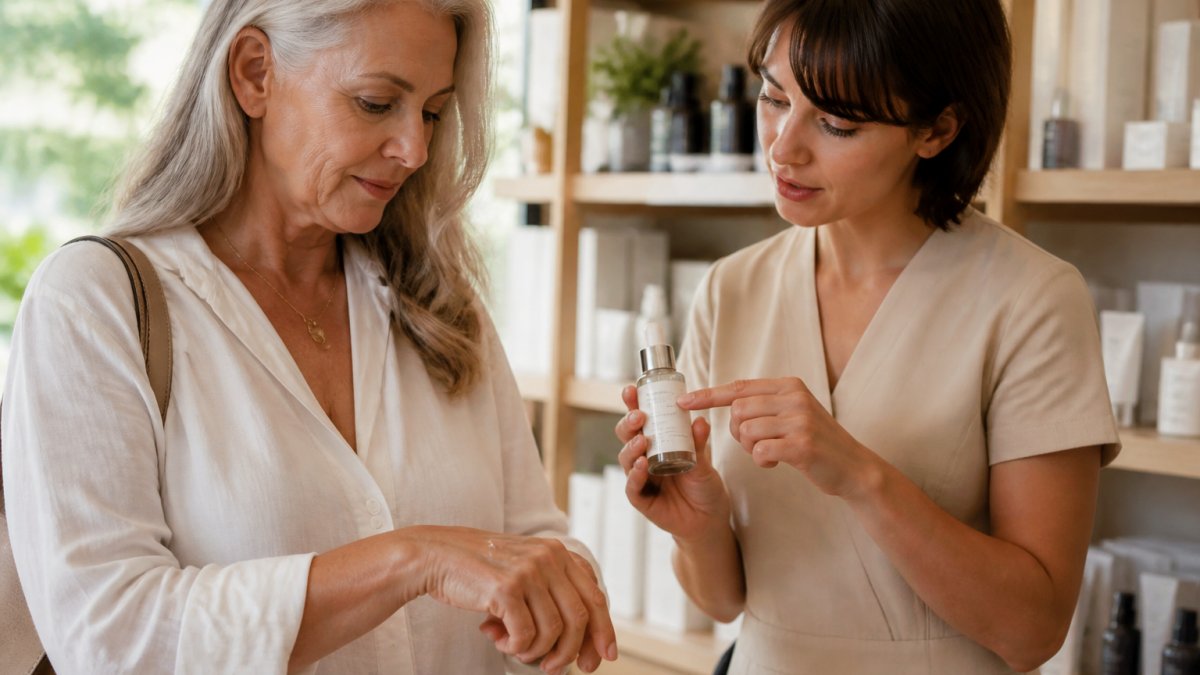
Sampling and shade matching solve the two most common regrets: a moisturizer that irritates sensitive skin and a foundation that never looks right in daylight. Ask to see the product applied in natural light near a window. For makeup, test on the jawline, not the hand, since hand tone rarely matches the face.
After-purchase support is the quiet benefit. A boutique that knows your purchase can tell you how to layer it, when to expect results, and what to do if your skin pushes back.
Beauty Boutique vs. Big-Box Store: Price, Service, and Selection
The beauty boutique vs. big-box store comparison isn't really about sticker price. It's about what you get for it. Big-box stores win on convenience and volume. Boutiques win on guidance, curation, and follow-through. The honest version of this comparison separates four things shoppers tend to blur together: unit price, cost per use, service value, and discovery value.
| Factor | Local Beauty Boutique | Big-Box Store |
|---|---|---|
| Service | One-to-one, knowledgeable staff | Self-serve, limited help |
| Selection | Curated, often exclusive brands | Broad, mass-market brands |
| Testing | Generous sampling, shade matching | Testers, minimal guidance |
| Returns | Often flexible, staff-handled | Policy-driven, receipt required |
| Value | Fewer wasted purchases | Lower unit prices, more trial and error |
Unit price. A boutique may charge more per ounce than a chain for a comparable category. That is a real trade-off, and it is fair to say so. If your only goal is the lowest price on a product you already know works for you, a big-box store or an online retailer is often the cheaper route.
Cost per use. The math changes when a product actually gets used. A serum that suits your skin gets finished; a mismatched one becomes a half-used jar under the sink. Boutique staff who ask about your skin type, sensitivities, and current routine reduce the odds of that wasted spend. Two avoided bad purchases can offset the boutique premium on the product you keep.
Service value. At a chain, the tester is on the shelf and the guidance is optional. At a good boutique, the guidance is the product. Staff can explain which actives do the work, how to layer them, and when to expect results. That is beauty-specific expertise, not generic retail friendliness, and it is the main reason to pay a boutique price.
Discovery value. Independent stores carry local makers and smaller labels that rarely appear on a big-box shelf. That curation is worth something if you want options beyond the mass-market set, but it is not a guarantee of better quality. Ask what the store stocks and why.
Returns and after-purchase support. Policies vary widely. Some boutiques offer flexible, staff-handled exchanges; others follow strict receipt rules. Ask before you buy, and ask what follow-up advice is available if a product doesn't suit your skin. A store that stands behind its recommendations is worth more than one that only stands behind a receipt.
The U.S. Small Business Administration notes that small businesses are central to local job creation and economic activity, which is worth remembering when you weigh where your beauty budget goes. None of this makes boutiques the cheapest option every time. It makes them the better value when expert matching prevents wasted spend.
Supporting the Local Economy and Your Community
Spending locally keeps money circulating in your neighborhood. Independent retailers hire locally, pay local rent, and often sponsor community events, and that ripple is the community support argument in concrete terms. Shopping small also protects community character: a street of independent stores feels different from a row of identical chain fronts.
The beauty-specific version of this argument is about what a boutique does with its shelf space. A local beauty boutique that stocks local makers shortens the supply chain and often encourages refills and fewer impulse buys, which lowers waste. That is an environmental benefit you can verify by asking where a product is made and whether refills are offered.
There is also a practical community benefit that broad local-shopping articles miss: a boutique that knows its regulars can host shade-matching events, skin-care workshops, and inclusive beauty consultations that a chain rarely offers. Those events build local expertise and make the store more useful to people with sensitive skin, mature skin, or hard-to-match undertones.
Convenience still matters, and online shopping has its place. But when you can test in person, buy in person. The community argument is strongest when it is specific: ask who made the product, where it was made, and whether the store supports local makers. If the answers are clear, your beauty budget is doing more than buying a jar.
What to Look for in a Local Beauty Boutique
A good local beauty boutique does four things well: it asks questions before recommending, it lets you sample, it explains ingredients clearly, and it stands behind what it sells. Use this checklist on your next visit.
- Staff ask about your skin type and goals before suggesting products
- Full ingredient lists are available on request
- Testers and samples are offered freely
- The return policy is explained up front
- The selection feels curated, not random
- Staff can explain sourcing and transparency for featured brands
- The store carries options for sensitive or mature skin
If a shop can't answer basic ingredient questions, that's your signal to keep looking. Expertise is the whole point.
Conclusion
Finding skincare that actually works for your skin shouldn't mean gambling on jar after jar. Ageless Glow was built for exactly this: a curated collection of targeted skincare, nutrient-rich formulas, and beauty tools and facial devices designed for visible results on fine lines, dark spots, and hydration. If you're ready to stop guessing, explore our collection and add to cart with confidence.
Frequently Asked Questions
Why do beauty boutiques charge more than big-box stores?
Boutiques often carry smaller, independent brands that don't have the same volume discounts as mass-market chains, and they invest more in staff training and personalized service. That higher price often reflects a curated selection, fresher inventory, and expert guidance you won't get from a shelf-stocker. When you compare value, factor in the cost of buying three wrong products at a big-box store versus one correctly matched product from a boutique.
Can beauty boutique staff really help me choose skincare products?
Yes, and that's one of the strongest reasons to shop in person. Good boutique staff ask about your skin type, concerns, and current routine before recommending anything. They can explain ingredients, demonstrate application, and flag potential irritants. Ask how long they've been trained and whether they've used the products themselves. A knowledgeable staff member will steer you toward personalized skincare recommendations rather than the most expensive item on the shelf.
Are products at local beauty boutiques worth the price?
They can be, especially when you factor in sampling and returns. Many boutiques let you try a product before buying or offer generous return policies, which reduces the risk of wasting money on something that doesn't work. The price also supports local jobs and independent makers. Compare the cost per use and the value of expert shade matching, then decide. For anti-aging or sensitive-skin products, getting the right formula the first time often costs less overall.
How can I tell whether a beauty boutique carries authentic products?
Look for sealed packaging, batch codes, and expiration dates on every product. Ask the owner where they source their inventory and whether they buy directly from brands or authorized distributors. Authentic boutiques welcome these questions and can often show invoices or brand authorization letters. If a price seems dramatically lower than everywhere else, be cautious. Building a relationship with a local shop you trust is the best long-term protection against counterfeit skincare.